Transcript
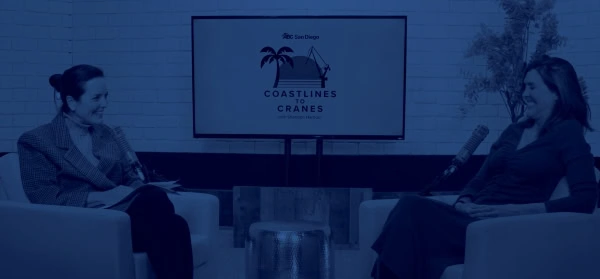
Good morning, San Diego. Welcome back to Coastlines to Cranes. I'm your host, Shandon Harbour. And today we're talking about something you can't pour in concrete or lift with a crane, but it might be the most important thing you can build on a job site. And that's your workplace culture. We're also going to touch on in today's episode, something called psych safety. And we're going to bring a subject matter expert on that as well in future episodes. So stay tuned for more episodes. But here today, we are going to talk about why culture matters in construction.
And right now, culture is very much the buzzword. It's very on brand, as people like to say. Company culture. You get a lot of folks that are talking and recruiting and they're saying, you know, people don't nowadays necessarily just want a salary. They want a place of belonging. They also want to feel like there's a really good company culture that they're going to be able to be part of. It's interesting when I do a lot of interviews for candidates at ABC San Diego, and I ask them, what are they looking for in their next company, their next career?
You know, what's their ideal situation? And 90% of the time, the responses are they're looking for a great company culture as part of their answer. And so here we are, we're talking about why it's important in construction, why it's important to your companies. And we're also going to talk about how to build that culture within your companies. So let's start from a couple of the main things. Culture is important because it helps build retention. When you do have a positive company culture, retention numbers go up. Turnover goes down. As we all know, turnover is very costly to any company.
The cost of onboarding, recruiting, bringing new candidates in only to have them turn and leave either by their own or it wasn't a good hire or not fitting into the company culture, that all costs the company money. And it's demoralizing to the rest of the team as well. It really takes down morale when you have high company turnover. For an association, when you have high turnover, it's very challenging for the members because members tend to stick or stay around when they have a relationship with your staff. So we realize that at ABC San Diego, that if there's high turnover in certain positions, the members who are growing with relationships with those staff and there's high turnover, we tend to see dissatisfaction with results on how we're connecting with our members if we have high turnover.
So it does impact companies, associations, definitely impacts the construction industry. And so if you have a great culture, it will keep employees longer than if you have a toxic environment. So that's one reason. The other reason is safety. This is where I talked about psych safety in the intro. Psych safety is another big term going around right now. And what is that? That is when employees and staff members feel safe to talk about certain things or approach their supervisors or they have a relationship with others that they work with such that they feel comfortable speaking up.
And that's so important in construction. I can't express how important that is. Again, as I mentioned, we're going to have a subject matter expert on a future episode related to psych safety. Because a story recently came out with that Titanic gate issue where, unfortunately, that little capsule had that tragic accident. The engineers and everybody have all come out saying that was 100% avoidable. And why was it avoidable? Because they knew that there were cracks in the vessel and they had experienced prior breakdown issues in the vessel. But nobody wanted to speak up to tell anybody else about it.
And they continued to submerge the vehicle in the water. And on that last one, it clearly could not withstand the pressure. And lives were taken as a result of that. And so that is a classic example of not having a culture of psych safety where people could speak up and say, hey, there's an issue here. And in construction, how important it is to have a culture where people feel comfortable speaking up and saying, hey, this ain't right. This isn't going to go well. Or this doesn't look like it's firmly secure. And it's not about tough.
It's not about weakness. It's about having the ability to feel comfortable to speak up. And that is where building a culture around psych safety, safety matters. These are all critical things in construction. The other part is construction. There's a culture of legacy. You pass down skills, things that you've learned. You've talked about traditions in construction. And so all of those things build on a positive workplace culture. When I think about, OK, ABC San Diego has this cowbell and the culture that we've created amongst ourselves as a staff, as an association, we are the San Diegans.
And I can tell you that I've been in other associations in the construction industry that are also from San Diego. And we have a vibe. San Diego definitely has a vibe. And people roll their eyes. They go, oh, Shandon, you know, San Diego. Whatever. We all have a vibe. I disagree. San Diego is special. And all you San Diegans listening, you know this. You know we're special. We are the special cul-de-sac at the end of California that has got ocean to one side. We've got the Baja, California border to our south. We have the deserts out there to the east.
And we have the mountains up there to the northeast. And so because of that, we have this phenomenal culture in San Diego that is very outdoorsy. We've got this beachy sort of laid back. We're not L.A. We're not O.C. You get that. This is all driving to my point that the more we can build these wonderful cultures within our companies in San Diego, the better off we are. And so the celebrate the wins is part of it. The cowbell, celebrating the wins, recognizing your workers, you know, just a simple cowbell, something like that. Ring it when something wonderful happens.
And that's not for everybody, but that might be what it is for us. And so you do that. You also give people the ability to speak up. Give them the voice. Make your conversations people-centered. Talk to them in a way that is coaching. And ask them how things are going. Let's see, can we talk about things that are going well for you? And let's talk about things that are not going well. And those are the ways that we build culture, building trust, building confidence. Those are all things that build a positive culture in companies. And it also carries on, as we mentioned in previous episodes, with mental health, asking people how they're doing.
Just taking time out of your day to say, you know, how are you doing? And not a glib answer of, like, yeah, things are good. No, really, like, how are things going? And you'll find that through these conversations, you get to know the folks that you're working with a little bit more. And you learn the things that make them tick or why they do what they do. Those are all the special things. So the last thing I will say, and the story that I will tell, is that it all starts from the top. Leaders have to set the example.
And if you're a leader in your company, whatever role that might be, manager, leader, executive manager, leader, executive leadership, or president and CEO, leader, it all starts at the top. The saying goes, a fish stinks from the head. So if it's bad, it's also your problem. But it all starts at the top. So you have to be willing to be a little bit vulnerable. And you also have to be a little bit willing to get feedback yourself. My example is recently I had a couple of 360s done, which for those of you who don't know, it's a professional development tool that can be used to help leaders get a full view all the way around from those that report to you to those that manage you or have an oversight or direct you.
In my case, it would be our board members and our trustees, our direct staff, and then other people that might interact with you on a peer-to-peer level all provide feedback anonymously. And you have to be willing to accept that feedback, whatever it is, and be willing to look and see like, oh, as my friend Lisa, who will be on our show at some point, will tell you, you have to be willing to accept that somebody could come up and say there's toilet paper in your pants. You know, it's hanging out. You can't see it. You can't see it because it's behind you.
But the feedback on a 360 is saying, hey, this is something that you need to fix and be willing to fix it. And when a leader is open-minded like that and can take that feedback, it's not always easy to hear, I'm going to say, then that's where real strides can be made. And that's where you develop that culture and loyalty from your team. And a lot of the ABC San Diego folks will tell you I have something on my wall that I got from my family business, I think it was my grandfather's, and it talks about loyalty.
And it says, you know, hey, for as long as you're working for a person, you need to stay loyal to that company and don't talk about that company negatively and don't talk about the leader negatively. But once you leave that company, you can talk to your heart's content. But as long as you're within the company, loyalty is key. But it's not automatic. I will say loyalty and trust are earned by the leaders. And so in order to do that, you have to be willing to accept feedback, be vulnerable, and be in a place that's celebrating the wins, the small wins.
You don't have to wait for the big wins to celebrate. And celebrate the hard work that everybody's doing as a team. So I will go on and say the last thing is that you need to walk the walk, not just talk the talk as a leader. It's hard to do, but actions are viewed more so than words. So closing it out, I just want to remind everybody that culture is why people stay. It's how they work, and it's what they pass on. And at ABC San Diego, our cowbell is our reminder that culture is built on little wins, one win at a time.
And so I close this out by asking everyone, what is your cowbell? What is your job site culture? What is your company culture? Find it, build it, celebrate it, and ring it off in. Alright, that's it, closing out this Coastlines to Cranes. If you love it, hit subscribe, read the show notes, leave us a comment, tell us what you want to hear. Until then, stay classy, San Diego.
Thank you.