Transcript
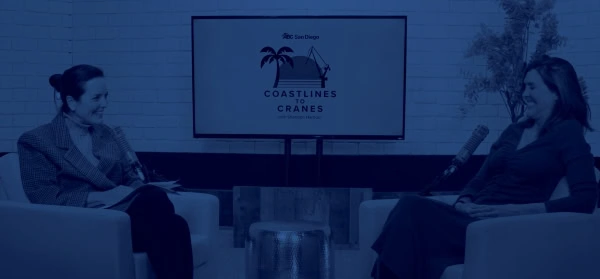
Good morning, San Diego. Welcome back to another episode of Coastlines to Cranes. I'm your host, Shandon Harbour, and this is the original construction podcast where we bring you everything from the coastlines to the cranes, the people, the culture, the industry, the trends, the politics, and everything in between. And today, as our guest, we have a really good friend of mine. He was a former city council member, and he has a very strong background in policy and infrastructure and public service. He went on later to start his own whiskey company. We might be sharing a whiskey or two after this episode.
But please welcome us, the new president and CEO of San Diego County Taxpayers Association, my friend Mark Kersey. Welcome. Thank you, Shandon. It's great to be here. Yeah, welcome. And you're the city council guy that I always used to call the GQ city council guy. So always a great friend and doing a good job for all of us. And so, you know, I got a call from our friend Kevin Faulkner, and he's like, Shandon, I got some news. He's like, Mark Kersey is looking at taxpayers. I was like, what? Oh my gosh, no way. That would be amazing.
And he's like, yeah, yeah, it's really going to happen. I think it's going to happen. And so, you know, we chatted and then you were announced and you called me and you're like, I'm back. And I was like, yes, the band is back together. This is so great. You know, I had Chris Kate on on a former episode and Amy Fawcett was on a former episode. And so we've got you, you know, the team is, it reminds me of a major league, that old movie with Charlie Sheen, where they go around and they pull everyone back together and we're creating this winning energy.
But, you know, Amy and Chris are very much about members and business and pro business. And we're kind of shifting gears in talking to you, Mark, today, because you're really representing the taxpayers, the city and county taxpayers of San Diego. And my history with taxpayers goes all the way back generationally when we had a business in San Diego. My dad's like, you really need to be involved with taxpayers because you need to understand the policies. And so, you know, I guess just to open it up, Mark, my question for you is, you know, as a taxpayer association, what are the things that you guys are looking at?
Like for our listeners that don't know what is the taxpayers association and why should I care or be involved? Because we have a lot of businesses that would, you know, benefit from this. What does the taxpayers do and what, you know, what do you guys look at? Well, the San Diego Taxpayers Association is the region's largest, oldest, and most respected advocate on behalf of taxpayers and government watchdog. And that's really our goal is to serve as the representative for taxpayers, both individual taxpayers, as well as businesses, both large and small. And really advocating for pro-taxpayer policies, transparency, efficiency in government spending, efficient use of the taxes that we pay, and a, you know, skeptical eye towards new taxes.
We're not always just completely anti-tax, but we are tax skeptical because we want to make sure that the government at whatever level is spending the money we give them well already before they ask us for more money. And so that is really our goal is to carry out that watchdog function and then also advocacy for taxpayers. Wow. That's amazing. That's very tall order these days, Mark. Oh my goodness. All the different taxes that are coming at us really quickly. But you did mention like the oldest. How long has taxpayers been around? It was started the week after World War II ended and it was started by a group of local businessmen.
I had no idea. Yeah, it was started in 1945 and it was started by a group of local businessmen who were concerned as we shifted out of the World War II economy that our region, both the business economy as well as the governmental side were going to need to transition from a wartime focus to a post-war focus. And so it was a lot of folks who were in the construction industry, names like Hazard and Fenton, like very, you know, well-known names in San Diego history. And they teamed up in 1945 and started the taxpayers association.
And so, uh, you know, it's, it's, uh, again, we've been around for 81 years. So cool. There's, there's, there's a lot to do that our, our, our local governments keep us busy. Amen to that. Right. Um, so yeah, in educating the listeners on the ballot initiatives, what are the things that, you know, voters may not understand about these ballot initiatives that come through? I have to be honest myself. It's a lot of reading and trying to figure out like, yes or no, is this good or bad? And I mean, how does taxpayers help your average voter, I guess, or business owner on understanding all of this?
That's really one of the most critical things that we do. And we spend a lot of time on this because there are so many ballot measures for voters to sift through. And, uh, you really have to be able to get past the rhetoric and get past the kind of flowery language and promises and things like that, and really delve into what are the specifics? What is this measure that's promising all these things? What's it actually going to do? And, uh, you know, because of all of the things happening at the city and county levels, there are just all of these tax measures and bond measures and other fiscal measures that are on the ballot this year.
So on the June ballot, we only have a couple there's measure a in the city of San Diego, uh, which is the non-primary homes tax. Okay. And this is something that we could talk more about if you would like. Uh, and then there's one up in, uh, kind of the Oceanside, uh, Vista area, uh, the Tri-City health care, uh, merger of that district was sharp. And so, uh, we support the, the Tri-City sharp issue. There's no tax implications to voters. It's really just a management issue that we think will benefit everybody up there. So, uh, we support that one and in the city we're, we're opposed to measure a, and we could talk more about that, uh, if you'd like, but the, uh, the, the, so that's the June ballot.
The November ballot is going to be very crowded. I was going to say, I'm hearing a lot of like scuttlebutt on all kinds of stuff. Absolutely. I mean, cause in addition to all the candidate races that everybody's going to be paying attention to, uh, there's going to be all of the ballot measures and there's going to be tax measures in various cities. There's going to be a tax measure at the county. There's going to be bond measures at various school districts. And so there's a lot to sift through. And so we take that responsibility very seriously.
I am so, I'm so fascinated right now. Like I had no idea and you've only been in the role of like six months, three months, three months. I mean, you've been spooled up pretty fast. You're, you're speaking very eloquently about all of these things and like all of the research that has to be put into understanding ballots and guiding, you know, guiding voters on which way to be looking into it. Um, how did you have this calling to come back to the taxpayers? That's I'm fascinated with this cause you know, making whiskey is pretty much a good life.
Like it was, I was having a pretty good time with it. What happened? Somebody called you and be like, come on, Mark, you can do this. And it's, this is a lot of work. I mean, this is a lot. It's a lot. And, and I, you know, I spent, as you mentioned, eight years on the city council in San Diego. And when I left in 2020, uh, not to say everything was perfect, but the city was in better shape then than it was when I got there in 2012. And, uh, and so I felt pretty good about a lot of the progress that we had made, particularly on infrastructure, which was, as you remember, my big issue.
Yeah. And, uh, and so I felt pretty good. And then unfortunately coming out of COVID, you just watch a lot of the, uh, budgetary decision-making that was happening, uh, primarily at the city and the county, but also the smaller cities as well. And, uh, it, it's, you know, it's kind of like the godfather just when I thought I was out, you know, they pulled me back in and, uh, and, and that's what it felt like is, is there's only so much of, of watching, uh, the region backside that you can stomach before you feel like, Hey, I just, I got to get back and play some, some small role, whatever that might be in helping right the ship here.
And so that's what brought me back. There you go. And, and, and at a very busy time, like you said, there's no shortage of initiatives, ballot things, lots of things happening in San Diego and the county. Um, talk to us about the process, you know, that just a little bit on taxpayers, you say that you take it very seriously. I happen to know internally that there is a lot that goes into it, but you know, who does the work? You have a research team and, or, you know, the analysis, is that you, you know, tell our listeners, how does it all come together?
Cause there's a lot of things that have to be dissected. If you will, there are. And from a staffing perspective, we are small, but mighty. I've got a policy director and we're going to have some interns, uh, here once the, uh, the academic year finishes here this month. And, uh, so really full-time, it's just the two of us, right. Uh, ideally we'll have maybe a membership person in the future, but, uh, that's, that's really it from a, from a paid staffing standpoint. And so, uh, we do rely a lot on our, our board members and our volunteers to, uh, serve on committees and help vet all of these proposals coming through because particularly right now, there's a lot, a large volume of, of work that's happening kind of all at once.
Right. And everybody, you know, all the cities and the county and the school districts are all looking to get their measures, uh, finalized so they could put them on the November ballot. And so, and most of them want our support. Right. Obviously they're not going to all get our support, but they most, for the most part they want it. And so, uh, we do a fairly extensive vetting process that really starts with the staff and then it goes through our committees and then ultimately winds up at the board for the actual endorsement or not. And so that's just the basics of how the process works.
And, and there's a lot, there's a lot to it. And, and, and really, again, that's what we pride ourselves on is really diving in. It's not, you know, just a cursory look. It's we're nonpartisan, right? Right. We don't endorse candidates. We're, we're, we're not partisan. Uh, we, we really focus on ballot measures, focus, focus on, uh, city and county budgets. Right. So we, we do analyses of the budgetary process right now. We've got the mayor's proposed budget, uh, you know, that we're, we're diving into quite a bit because there's a lot of cuts. There's a lot of, a lot of action there.
A lot of, a lot of, a lot of things for us to dive into. Yeah. And, and you're familiar with it because you've served on city council, so you know exactly what you're looking for, but it's great for our listeners to understand that these are actually volunteer members that serve on committees and on the board. They're not paid. You know, these are people that are analyzing it with you and the staff and everybody that's involved in researching it. But ultimately these are taxpayers and people that are volunteering to produce, you know, the outcome of, Hey, this is good for us, or this is not, this is not good.
Careful. You know, it, it might be a sheep, a wolf in sheep's clothing, if you will, you know, those fancy words safeguard. I always, I know that when I was like safeguard, wait a minute, does it really safeguard? I'm not sure. Um, so yeah, I think it's a fascinating process. And, uh, like you said, it started with hazard and Fenton back in the day, it's still true to form construction and some of the other industry businesses that are around the table for your serving on your committees and on your, on your boards and, um, not just construction now, but of course, you know, lots of defense industry, you know, different leadership industries that are involved in San Diego.
That's right. And that, that was really one of my priorities was putting together a board that was representative of our entire region. Perfect. And, and so I want big companies. I want small companies. I want individual taxpayers. I want retirees, uh, homeowners, renters, uh, education folks, uh, construction industry folks, you know, uh, tourism industry folks, you know, all technology. I mean, all the big sectors that really make up our economy. I want those represented because we're all paying taxes, right? Whether we like to or not, they're a necessary evil and they're not going anywhere. So, so, uh, you know, it's, I think it's important to have an organization, uh, that really mirrors the, the region as a whole, and then have a board that, that obviously reflects that.
So that, that was really our goal there. And, and, uh, we're still adding folks, but I mean, we've really beefed up the board. We've added 15 new members in the last couple of months. And so that's been great to see. And, um, you know, I think that's reflective on, uh, people understanding the, the importance of the organization and the need for it, particularly right now with everything going on and your leadership and your leadership, because they, you know, the last three months I've seen transformative things happen at taxpayers, you know, is, uh, just quiet there for a little while.
And, and I thought it was six months, but you said it's only been three and you've literally turned it around on a dime. And I thought, okay, this was a longterm and, you know, I, I anticipated seeing a longterm process to get going, but you're up and running, ready to go, you know, analyzing ballots already hitting, um, you know, this midterm session coming up in November and everything. So kudos to you for, for stepping in and wanting to come back and play ball with all of us out here.
Well, you know, the ballot doesn't really care about my timeframe, right? The ballot's going to be in June and it's going to be in November. That is so true. We had to be ready. And, uh, and so we're diving right in. So tell us a little bit about cast to coast. Is it still, are you still doing the whiskey thing or is that, you know, kind of, I guess you can set it and forget it for a while or no, you're still still doing it. It's become a little bit more of a side hustle right now.
You know, I was happy to be a gentleman, a bourbon purveyor, but, uh, but, but now it's more of a side hustle. And, uh, so we still, you know, we still do tastings and things like that. In fact, we've got one later tonight, uh, down in, uh, uh, in, in Point Loma. So, uh, you know, we still do things like that and it actually works out well because a lot of this, those kinds of events are already in the evenings and on the weekends anyway. And so those two, they actually kind of work very well together.
Absolutely. You know, are you kidding? Anytime there's whiskey with construction. Yeah. Yeah. You're right. And, uh, and so I think, you know, we may wind up doing, you know, a whiskey themed event or something like that at taxpayers. So, you know, try to blend the two worlds. Maybe we'll see. Fantastic. Well, it's been great having you as our guest today on the podcast. Thank you for being here, Mark and listeners. That's it for this episode of coastlines to cranes. If you want to get to know about San Diego taxpayers, look them up on their website.
It is San Diego County taxpayers association and tune in. If you'd like to give us a like subscribe or leave us a comment. We'd love to hear your feedback. You know how we always end this episode. Stay classy, San Diego.