Transcript
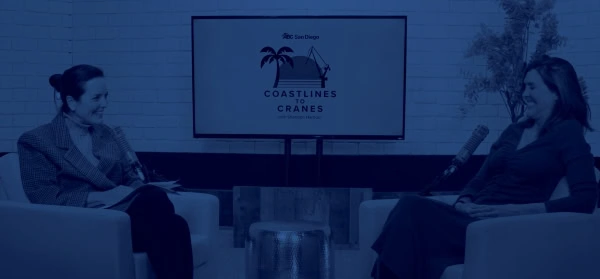
Good morning, San Diego. Welcome back to another episode of Coastlines to Cranes. This is the podcast for the construction industry, where we cover everything from the coastlines to the cranes, the people, the culture, the job sites, the industry news, and everything in between. I'm your host, Shandon Harbour, and welcome back to another episode. Today's episode is a little bit different. It's just me. I'm here to have a chat with you about something very topical that's hitting our industry, similar to the way the gold rush hit California. It's called data centers and artificial intelligence. So let me tell you a little story.
About two years ago, my son, who is now graduating from San Diego State, go Aztecs. He was about a sophomore going into his junior year, and he's sitting on the couch. He was home from school, and he said, Mom, you know what? I'm going to tell my kids that I was born during the Google era. Now, at the time, I had absolutely no idea what he was talking about. I wasn't sure. I was like born during the Google era. I mean, we've had Google around for a long time. Sure. Yeah, you're born during the Google era.
What does that mean? Because at the time, I couldn't see where Google would, in essence, one day be obsolete. Or, as we all like to say it, Google that. You know, Google it. Google it. So now, fast forward, I was sitting in a conference last week at the ABC One conference where great minds and thought leaders come together. The speaker was Nick Espinoza, and he was talking to us about the fact that Google is, in essence, on its way out, if not already extinct. Now, Google itself, the company is still around, of course. But really, how many of us Google anything anymore?
We really just ask chat, right? He asked around the room, I mean, heck, my chat's name is Bert. I don't even go to Google anymore. I just asked Bert, Bert, what should I wear to this? Bert, what do you think about this? Bert, tell me about what's going on here. That's chat, GBT, otherwise known as OpenAI. We also have Claude, Grok, and a number of other AI bots and things that are out there. So when you look back to what my son said two years ago, where mom, I'm going to tell my kids that I was born during the Google era, he's actually right, because AI is definitely on its way in.
So you're saying, okay, well, Shandon, what does that have to do with construction? This is a construction podcast. Aren't you supposed to be talking about the trades, where we're going, what's happening in construction? Well, if you look at the last year in economics and construction, data centers are actually what's propping up the construction industry. We hit a low hit around July. I can tell you anecdotally, it started to slow down. Trump's tariffs came into play. There was a lot of concern around immigration. There was a lot of cautiousness. And then we hit the government shutdown.
So you take all three of those things. And October, November, December was probably one of the slowest times we've seen in recent history in construction. But yet there's this anomaly that's happening out there called data centers, which is artificially or, or officially propping it up. So you say, well, gee whiz, Shandon, data centers are never going to happen in San Diego. Why would you ever be having this conversation in San Diego? Because really, the data center markets are blowing up in places like Loudon, Virginia, which I guess has been happening for many years. And then you've got areas like Phoenix, Texas, Florida, Ohio, these are all the hotbeds of data centers.
But I'm here to tell you something. It's happening in San Diego's backyard in the Imperial Valley. If you haven't heard the news, the Imperial Valley, that council just voted to permit a megawatt hyperscaler data center in the Imperial Valley, the size of 17 football fields. Now, if you can imagine what it would take to power and cool 17 football fields of a data center, that is quite a lift. It's just in essence, putting something that needs water desperately in the middle of the desert on an already very strained Colorado River. And maybe you can tap into the Salton Sea.
It waits to be seen. Again, you say, okay, so this giant data center is being built in the Imperial Valley. What does that have to do with construction? Well, the big issue is that, and what I say, the juxtaposition of this whole conversation is that the advancement of technology and artificial intelligence is wholly dependent on the skilled trades. We can only build as fast as we have electricians, plumbers, low voltage technicians, cabling, HVAC folks. These are the trades that are being tapped to build and advance artificial intelligence or a.k.a. ChatGVT. So our advancement is dependent on the trades.
And you think, wow, that's a really interesting situation to be happening. But if you recall, we've been talking about the workforce shortage now for quite some time. We're already short nationally, three hundred and forty nine thousand in the skilled trades. And that is a number that does not take into consideration the data center construction. So we have already had a shortage with infrastructure. Our roads, our underwater piping, our sewer systems, all of these things, our bridges are well past the date of where where they need to be restructured. We've already identified that our infrastructure in the United States has to be redone.
And yet now, in addition to that, we have this demand for workers. And here's the interesting part. Never before have we ever had such a demand in the sense that the rate of pay for construction has, interestingly enough, never really spiked. Even though there's this huge demand for the trades, the trades price or the wages that they earn has remained relatively stable despite the demands on the infrastructure and everything else that we've been needing. But enter the data center players.
Those folks have so much money that they're doubling the salaries of electricians and plumbers. And so what's happening in our local force is that our local mom and pop mid and small and mid-sized contractors, the fabric of San Diego, are having their workers plucked from their companies to go work on these data centers. In fact, I can tell you that as an ABC training facility, we lost two instructors about two months ago who literally came to my desk and said, "Shandon, we've been working for you for a long time and we love what we're doing at ABC, but I've been offered quote unquote stupid money to go work on a data center.
I have 10 days on, four days off, and I'm going to be able to put away some really amazing money. I can't miss this opportunity." And of course, I said, "Yes, you have to go after it. You would be a fool not to go after it." And so I look at it as though the time that we're facing right now in construction and data center construction and artificial intelligence advancement is like the gold rush. And so I go back to my original opening that the gold rush in California is going to be data centers. The gold rush in construction is going to be data centers.
In fact, my nephew who lives in Oregon is moving to San Diego in the next month to come down because he told me, "Aunt, I want to be part of this. I want to be part of the data centers." And so he's going to get into the trades. Heck, my own son who's graduating from San Diego State in two weeks is looking at it saying, "Is it really this good? Should I be getting into the trades?" And so that's the interesting anomalies that are happening right now in data center construction and artificial intelligence. So there's one other part that I want to talk about since we're talking about all of these things related to artificial intelligence and data center construction, how it affects the economy, how it affects our community, how it affects the San Diego area.
I want to talk about how it's impacting our training, actually integrating AI or artificial intelligence into our training. And you think, well, what, why that's, I mean, I hear people rolling their eyes all the time.
Don't bring AI into the training. I mean, this is the skilled trades. What place does AI have in training? Well, here's a little story for you. So there's a school in Austin, Texas called the Alpha School. And the Alpha School is a private school where parents are paying up to $70,000 in private tuition to have their student educated by artificial intelligence facilitators. If you can believe that, you're probably sitting there thinking we're coming to the end of the world as we know it. But give it a thought for a minute. Here's AI facilitated instruction, where the student isn't intimidated to ask questions, because questions are answered like a tutor one on one.
And they have the confidence to ask the questions. How many times in class were you as a student sitting there thinking, I think I know the right answer. I might know the right answer. I don't know if I have the right answer, but I'm not going to raise my hand and find out because I am too embarrassed. What if I say the wrong thing? And so by interacting with AI, or AI facilitated instruction, the students are having two times up to five times the outcome is more improved than if they were sitting in a class with a regular professor or instructor or teacher.
And that's why the parents are investing in AI facilitated high schools. And so I bring that to ABC San Diego. We are currently partnered with a program called Global E-Training. And it is AI facilitated training. You can go online now, we have a brand new website, it just launched a week ago, where you can take AI facilitated instruction on a number of classes. We have up to 26 different programs that you can go online and take that's AI facilitated. Everything from coaching you in auto desk to blue beam to p6. I know members had called me before about p6.
And there's a host of opportunities for people to take through AI facilitated instruction. So it comes all the way around. We are using it in our day to day life more than we know. If you're using Siri, or if you're even using some of the the apps that are available, those are all actually powered by AI, more so powered by your skilled and trained workforce. Because that's the ones who are bringing it to you every day. Last but not least, I will tell you that bringing this conversation all the way around is that on social media, I saw yesterday, it was a post where a gentleman said, all of our companies are being pilfered for data center employees.
And that's where ABC San Diego can come into play. We are a membership organization that helps mid size and small contractors win work, develop their people, and provide the training. And so we're here because we know that there's going to be a demand, there already is, for electricians and plumbers and all of that that we can deliver on. But in addition, we can provide the backlog for those of you who are losing your employees to the data center gold rush. We are the ones that have extra folks that are here waiting to go to work for you.
So if you're ever wondering, hmm, do I, do I, should I join ABC San Diego? What should I be doing? Definitely give us a call. This is where we are your partner in construction. We can help you, we can give you the stats, we can give you the training, and we can also provide the workforce for your companies to win successfully on this data center crunch. To conclude, I'd like to ask the listeners, what are your thoughts on data centers? You know, it's a very divisive conversation. We've got people that would say, this is amazing.
We want the jobs. We need the economy. We need the industry. Don't wave off data centers because this is what we need to keep moving. And it's such a highly charged topic that there's the ones that are pro data centers saying, we can't afford to not have a data center in California. It needs to be here. If this goes through in the Imperial Valley, it will be the single largest data center in California. So pro data center folks will definitely say, we need it. We have, we cannot afford not to have it. Then you've got the other side.
What does this mean for our communities? What does this mean for the residents of the Imperial Valley, where their doorstep will open up to a huge door data center? What does this mean to the community where, what does that mean for our water, for our energy, for our land, for our ecology, for our environment? And so I'm asking the listeners today, what are your thoughts? I'd love to hear. And so this concludes another episode of Coastlines to Cranes. I usually say, if you like it, give us a thumbs up. But to conclude today's episode, I'd like to say, please write the comments, feed us back what you're hearing.
We're only as good as what we can hear from the community. And we're on this topic. We're, we will be covering it. We have submitted columns to various outlets. Hopefully you'll see one of us at one of the columns coming up in the daily transcript soon. But we want to have this conversation around our community. It's a very, very hot topic right now. So weigh in, we want to hear from you. And you know how I always conclude, stay classy, San Diego. We'll see you on your next episode. Feed us back what you want to hear.