Transcript
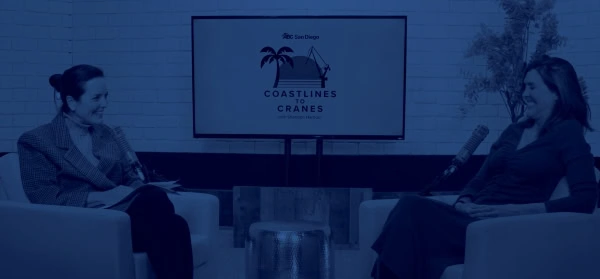
Good morning, San Diego. Welcome to Coastlines to Cranes. This is the podcast where we dive into construction from the sandy shores to the towering cranes and everything in between. I'm your host, Shandon Harbour, bringing you stories, insights, and conversations that connect the people building our communities. And the coastlines that inspire us. From leadership lessons to industry innovations, this is where construction meets culture. One conversation at a time. Today, we welcome Deirdre Maloney from Momentum, San Diego. One of my dear friends. Deirdre and I met at Downtown Rotary 33, the Rotary in San Diego. Thank you for being with us this Wednesday morning, Deirdre.
Excited to be here. Thank you. So, I know quite a bit about you, but tell us, tell the listeners, how did you get into this work? You are an accomplished author. We have three books in front of us that you've penned. My favorite, The Mission Myth. Very inspiring. And also, The Bogus Balance, The Work-Life Balance, and also a successful blogger. So, tell us about how you got into this work, about you, and then we'll get into how we connected most recently in this world. Thank you. So, excited to be here. Thank you again for asking me.
So, my work now, really, I started out really working solely with nonprofits because I was the executive director of one in Denver, Colorado. At a very young age. At a very young age. I came up from within, which a lot of us do. I got the executive director job at 28 years old. I had been the marketing director there. We had an executive director of 18 years. Stepped down. Our board, with the best of intentions, hired someone who, five months later, they had to let go. And they kind of looked around, and I was like, I think I know some things about what we need to do here.
And they were like, okay, well, we're not going to take another outside risk. But that's basically how I got the job. It kind of worked well. And frankly, I knew enough about the organization and the sector that I was like, if I get it, great. If I don't get it, that's okay, too. Because I know that to really take an organization and evolve it, which is really what we needed at the time, it was going to take a lot of work. It was going to take some suffering and some pain for me and for some other people.
I wound up getting the job. At the time, we were about $3.6 million as an organization. And what I knew really strongly is that we really had our mission down. This is what led to the mission myth. We had figured out our programs pretty well. We were well government funded, although uncomfortably so, because we didn't have a lot of diversification at the time. But what we really needed to do was build the business side of the nonprofit. And that isn't what we talked about at that time certainly enough. And so we didn't really have the right staff in the right seats necessarily.
We didn't have a lot of policy. We were much more organic. When you get to be multimillion dollar, you just can't do that anymore and have solid outcomes. So I really spent my seven years in that role, building up the business, hiring the right people who then did lots and lots of amazing work, keeping the people who were in the right position, completely changing our board model, trying to figure out our funding. So all the legs to the table that makes a nonprofit work, we think about what makes a nonprofit tick, which is the mission.
But what makes a nonprofit work and be successful is all the capacity and the people making it happen and the systems that will ensure that we are consistent over time. So I learned that making a ton of mistakes, which is also in the book, but really talking about why strategy and business is what brings us forward. Not super popular, not super sexy. So when we moved to San Diego, I really worked a lot with nonprofits at the time. I love nonprofits. I'd worked for one and I knew I really wanted to work with them moving forward and did a lot of work on all those business strategies as far as board retreats and strategic planning and staff and change management.
And then I just realized over time, as I met more and more people and worked with more organizations, that for-profits have the same needs, really. And so do universities I've worked with a lot. I've worked with associations a lot specifically. So I've been able to expand and do a lot of management training, which I think is really important. So that's kind of what brought me to now and the work I do, which is really I do management and communication trainings. I do facilitation of strategic plans and conversation. And I do coaching.
Hearing you talk about your experience brought me right back to chapters in the book. And I'm thinking, the narrative hasn't changed on a lot of nonprofits. There's still a lot of folks that are struggling out there. It's capacity. It's people. Boards. Do they have the right people in place? Trying people that come from outside in the for-profit world. Do they work well in the nonprofit world? The turnover. I mean, all the same, the same issues. And I remember when we met, you're like, I'll never do that job again. I did decide. Smart lady. I'm feeling a lot of what you're talking about.
No, I love this. And so here we are. We connected through downtown Rotary 33. I was at the time running our family business and you doing Momentum. And years later, I joined ABC and realized we need somebody with very experienced strategic planning, understanding the association world, boards, missions. So share with us what you do in the strategic planning sector and why that's so vital to not only, like you said, a nonprofit association, but also for-profit. Yeah. Right. Yeah. It's so important. And I know sometimes the word strategic planning just makes people's eyes roll out in the back of their head.
But what strategic planning is about, if I were to just boil it down to a word, is intention. The world is going to move madly on, right? It's going to spin madly on. The only thing we have that's constant is change. And so if we allow ourselves on a day-to-day basis to react, change is going to happen, whether it's external conditions like budgeting, like donor climates, like politics, like whatever that might be, the needs of the people we serve, the needs of our members, what they're facing right now. That's all going to change. And internally, things are going to change.
There's going to be things we can improve upon. There's going to be things we can enhance. There's going to be things we need to not do anymore. And if we don't think strategically and say with intention, we're going to make sure that we are keeping on and evolving in the same way the world is evolving, we're going to fall behind. We're going to let ourselves be pinballs who just go from thing to thing to thing to thing. We're going to let ourselves not think about intentionally what can we make better? What can we enhance? What are threats out there we need to address?
What are opportunities we need to leverage? Super consultant, SWAT-y kind of language, I know. But if we don't do that, we will react and we will not be as good as we can be. And when it comes to nonprofits, whether it's those that serve members, those that serve clients, those that serve patrons, whatever it might be, we're going to fall behind. Our outcomes aren't going to be as good. And frankly, the funding won't be there as much. So it's really about making sure we're as good as we can be. You saw me laughing while you were sharing pin to pin to pin to pin.
And since you're intimately involved in our strategic plan now, I was having an inner laugh moment because I was thinking, how does this podcast fit into our strategic plan? You know, like pin to pin to pin to pin. Here we are. Like, does it meet the goals of what we're trying to accomplish? And how many of the construction guys and gals are out there listening to a podcast or watching? I don't know. And that's the thing about strategic planning that we need to be careful about because we can make up a story that anything we're doing leads to something, a goal, leads to a goal.
This is when we need to have the discipline to be real. The other thing we do as nonprofits and really any organization is we get very attached to things. So we find reasons to not let go of things that maybe aren't serving us anymore or need to be involved because especially in the nonprofit world, we really identify with our organizations. We're there for the mission. That's why I called the book Mission Myth. We love the mission so much that sometimes that passion actually gets in the way of making good business decisions. And strategic planning, hopefully, we can call ourselves out and say, is this toward the plan?
Is it not? Different ideas are going to come up. We just need to be intentional of, are we going to make this turn strategically on purpose because it's cool or sexy or fun or whatever that answer might be. Yeah, likes and not members. Likes and not members.
So you just have to, it takes discipline for everybody involved to really stay the course. We don't do strategic plan as an exercise. We do it as an intentional blueprint to say, this is what we're going to do. The rest is, unless there's extenuating circumstances, this is not where we're going to put our energy because we all do have, we have limited resources. We can't pretend we don't. We're not going to get a 26th hour in a day. Right. So how are we going to spend our time? Exactly. Shiny new object, right? Exactly. Keeping us on track.
Yes. It's part of the strategic planning process that we go through. First of all, I'm just loving the conversation because every time we talk on the phone, whether it's planning for strategic planning or other things, I always get such a good laugh with you, Deirdre. So I'm loving this. Anyway, when we go through the planning process, we talk about technology and its role or lack thereof in the strategic planning process. So there's some pretty hard ground rules related to tech while we're doing the process. And it's a long session. It's a good, usually four to six hours.
Sometimes it goes longer or shorter depending on the needs of the organization. And there's typically some pushback on the technology rule. I'll let you explain that in a second. And then there's the ones that maybe she's not going to see or, you know, how that is a battle that we fight, not just in strategic planning, but I would say it carries through board meetings. It carries through meetings, Zoom meetings. How do we get everybody's undivided attention with the draw of technology? It's really hard. So you've seen it in action, Shandon. And so I have a ground rule where I go in and I just say, tech off the table.
And silenced, ideally, airplane mode if we can. Some people keep it to vibrate. And it used to be just even a couple of years ago that I could show up on a retreat day and put this ground rule out and I'd get some grumbles and mumbles and eye rolls, but they'd do it. And now I found that I have to let people know ahead of time. So I always make sure whoever I work with puts out an email and people still grumble, but they're aware that they can tell whoever's in their life that they're not going to be as accessible.
And I think what this speaks to is we went from using tech as a tool to tech as a whoopee. It's like our security blanket. And it is now a part of us in a way that doesn't always serve us. But now what I'm finding is when I ask people to put their tech away, their nervous system goes up. I've had people tell me, especially when I work with academics, I'm putting my brain away. I can't think without it there. Or, you know, and this is a fine reason. I have kids and I don't know.
But really, when we think about the phone, we look at it and it's like an unwrapped Christmas gift. Because if it's on the table, we're like, what's there waiting for me? What's happening that's important? What do I need to be a part of? What's going to maybe separate me from what feels a little tedious in this meeting? Or what feels a little bit stressful in this meeting? And we now use it to kind of hold on to it like a whoopee. Absolutely. And that means the rule has to be even harder because it's that much harder to separate.
And I'm telling you what I find is that at the beginning of the day, people are tense. Right. But by the time we get to toward the end of the day, I had a woman say to me a couple weeks ago, she's like, I was pretty pissed about that rule. And she didn't show it. Some people show it. We get some petulance sometimes. Oh, absolutely. And she said, I wish I could just never have it. Right. And the same woman who said she felt she was putting her brain away, I had to ask her three times to put her laptop away.
She said, at the end of the day, I have never felt so focused. Right. And what we're doing here with strategic planning or I mean, we are using our time, we are being paid or not or giving our time as volunteers or energy to come together in a room and have a conversation. We don't want to be halfway there. At best right now with phones out, we're halfway focused. Right. Because we all know that there's no such thing as doing two things at once. Multitasking, we all know, is a fallacy. We're just going back and forth, which means we're losing it and having to come back and losing it and having to come back.
Certainly when I'm doing my work, I'm being paid for it. I put my energy into it. Everybody's given their time to four to six hours. We don't want to have energy here. Right. If we're going to do it, let's do it. Right. And I think the thing is, again, we tell ourselves stories, why I need it, why. But, you know, we went a really long time without all this technology and we were OK. Absolutely. So I just think that communication and the outcomes, it matters. It matters. I couldn't agree with you more. And I always laugh and say, you and I, I mean, grew up with payphones.
At some point in time, we were in, you know, a payphone situation where my parents would get, you know, will you accept the collect call from Shandon down the street for a ride home? You know, we all survived and we all had one phone in the family house and we figured it out. But it's such a contrast from that. And I find that, you know, I got called out on a meeting not too long ago where I had been distracted and they were like, Shandon, what do you think? Oh, you know. So don't do a little cheater thing.
And half there was definitely the case. So I really appreciate that. And I think for all of our listeners out there, the more we can set the tech down and be present, even in your family lives, dinner time, whatever it is, more attention towards what's happening right in front of you. The tech wall, you know, that stuff will be there. We can get to that. Yeah. I think it's understanding it really is. It will be to us now. And there's something about losing it that's just more existentially threatening for some reason than it was before.
And it takes discipline. And you know me, I come in pretty, I come in and I always say I'm the nicest bad cop you ever meet, but I am from New York and I'm willing to, I'm willing to call people out. Right. And we need to do that for each other because we're really nice people and we all want our whoobies and it does make us feel more secure. So it takes an extra step of discipline and courage in a way to put it away. Right. But it's worth it. Yeah, absolutely. The outcome, our strategic plan came out fabulous and we're excited to implement that from 2025 and also we're going into 2026.
So that's a wrap, Deirdre. Thank you. Tell our listeners how they can find you. I know there's a lot of associations that are listening to our podcast here today and also non-for-profits as well. How can they find you? How can they reach out to you? Thanks for asking. So the best is to go to my website, which is makemomentum.com. And there you'll hear about me. You'll be able to contact me. We have all of our information there. And I love helping people just do their work better. And my line is that I help people do their work better and I help them sleep better at night.
Absolutely. Our board loved the strategic planning, both sessions that you've completed. They really enjoyed it. Lots of positive feedback. Even with the tech rule. So look, Deirdre, up. Thanks for being here. Hey, for all of you listeners, that's a wrap. If you love the show, give it a like. Very good. And leave comments, subscribe, and become a member. That's right. Stay classy, San Diego.