

Transcript
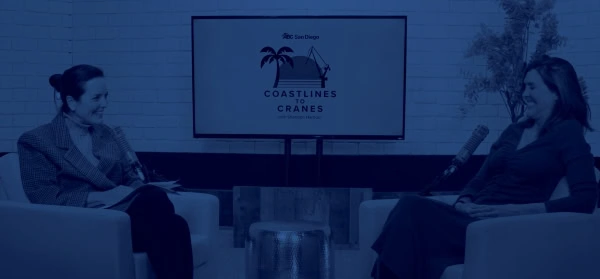
Good morning, San Diego. Welcome back to this episode of Coastlines to Cranes, your original construction podcast in San Diego, where we bring you the people, the culture and everything in between from the coastlines to the towering cranes. On today's episode, we have my best buddy, Corey Klinke. He is the Executive Vice President of West Coast Group Benefits, and he's got a phenomenal story to tell you. Also, he might be known as a good friend to my husband, Pearl, Earl the Pearl. Lots of good times with Corey, but today we're going to take a serious look and investigate and talk about the benefits of a health trust.
Welcome, Corey. Thank you. Thank you for having me here. So great. Before we started rolling on camera, you were telling me all about how you landed in this business. Give our listeners a little snapshot on how Corey, the basketball player from San Diego State, is now leading one of the largest health trusts in California. Well, thank you for that introduction. I'm happy to be here. And yes, I have been at West Coast Benefits for now a little over 25 years. So as we discussed earlier, I think, yeah, I've seen a lot. You're not you're not old enough to be there 25 years.
Oh, I am. And I feel that when I play basketball with my children. Yeah. And I can feel it in my back and my hamstrings and a little bit my Achilles. Yes, exactly. So you've been there 25 years. You've seen a lot. But tell us how you actually got here from the beginning. Like from the get go. I mean, I think I was telling you I was graduating from college and I wanted to be a teacher and a coach. That was my ultimate goal. And then I realized I had to let home for a certain amount of time.
And I realized that I didn't want that to be an option. This is good for my son who's coming back from college. Yes, yes, yes. Do not come home. I don't recommend sons living their fathers, especially in their early 20s. It's a it's a hindrance to your social life. And I knew that from the get go. You think the colonel would have something to say about that? Oh, boy. Yes, for sure.
Yeah. But yeah, so I end up playing in a men's league with a bunch of professional gentlemen. They're all in their late 30s, early 40s, all had families, all based on their cars and where they live. They were very successful. So I ended up talking with each and every one of them after drinks, after the game and found out. Yeah, the guy that plays a lot of golf and does well, turns out to be that kind of guy I wanted to be, you know, emulate. Insurance. Insurance. Insurance. And that's when your viewership just takes a dive.
Once you mentioned health insurance or any type of insurance is, you know, you can see the eyes glaze over. Fast forward. Fast forward. No one gets in this business to be an insurance. No one grows up thinking they're going to be an insurance. It's not something that you think about, but it's obviously something that everybody needs. Especially if you don't want to have health insurance or you want to have it when you need it ultimately the most. Absolutely. And you are like an ace card for all of us at ABC because when small, midsize and large contractors come to us and they say, you know, where do we go?
Who should we talk to for our health insurance? And we talk about our health trust. I always tell them, you got to call Corey with with West Coast. Now, tell our listeners, you know, what is the benefit of being part of the ABC health trust? Like, what is that? How do you guys differentiate that from just your run of the mill renewal? So so the good news is if you're joined as an ABC member, you have access to the ABC California Health Trust. It's been around since 1988. It's a federal risk of health trust. So it applies by all the federal risk of rules as well as Department of Labor rules and of course, IRS.
And it's the only option that I know of that allows an association such as this one to combine a buying power force of multiple employer companies. So in this case, I think we have almost 100 employers participating in the health trust. What that does is create a larger buying force. So when you approach a UnitedHealthcare, a Kaiser, an Aetna, Anthem, which is formerly Blue Cross or Blue Shield, you have a bigger buying force. And, you know, with California, especially if you're under 100 employees, you're what's considered age rated or you have book rates. But the ABC California Health Trust, you're looked at as a 2000, 3000 employer group that has composite rating.
So it's always good to take a look at that option. You always, you know, when I see a new group, especially, especially if they're under 100, they're used to age rated and they have, you know, rates change as their employees age. And if they have a higher ages, it really can get expensive. Fortunately for us, we have one rate for each plan that's based on a single employee, employee and spouse, employee and child or children, and then also family. And it's always a good option just to take a look at. It doesn't hurt. It doesn't cost anything.
You show what they currently have, what their renewal is, show the ABC as an option, and then show all the other options. We always show all options to all of our employer groups. And when you look at ABC Health Trust, there's usually savings. And then also there's the hour bank aspect when it comes to a prevailing wage. You know, sometimes you can take the annualization costs, which we help with, or you look at making an hourly contribution per hour per employee for every hour worked. And that amount can come directly off the fringe. You pay training if it's a state job, and then the remaining balance could be on the check or into a 401k, which is what it's ultimately designed for.
That's a perfect synopsis there, Corey. And I love that you mentioned the hourly banking and the hourly prevailing wage and how you guys can help with that. Because a lot of times our contractors or a prospective member will, what I'll say, bump into public works, right? And they get into it, and they're like, oh, I need an apprentice. And then the requirement is, oh, they need health insurance for their apprentice, and then they have to do the hourly banking. Very difficult to do unless you're working with an experienced health insurance company that understands hourly banking.
Not very many people understand that market. That's true. Well, I'm not an attorney, but I do understand the laws very well, especially when it comes to prevailing wage laws and the fringe benefits and the guidelines that we're supposed to adhere to.
And that's part of the service that West Coast Group Benefits offers. West Coast, you know, you and the company offer this wonderful service where our contractors can call you. A lot of times they have questions or, like, call West Coast. They'll be able to walk you through it. And that's an added benefit to working with you and the health trust as well. Absolutely. What would you say, you know, to a potential contractor? They call me, and they always say, you know, that's okay. I'm not going to give them benefits. I'm going to just pay them cash from the fringe.
Right. So they don't entertain calling you for benefits. What would you say to contractors that want to take the pay cash out scenario? Because I know you've got insight on that. Well, that's a good point. So we always will actually do the math with them. Okay. That's perfectly okay within your right to pay the cash's wages. We'll just show you what that looks like per hour. You take the, you know, the taxes, the payroll taxes. Then the workers' comp. We can work with the mod and really, you know, find out accurately how much it is, how much the payroll burden is per employee per hour.
Generally, it doesn't happen any much anymore. I don't run into that. I used to run into it all the time. Not so much anymore because you have to actually incorporate that into your bidding process. You have to lower that burden to even be competitive.
You know, I bring it, you know, I've been doing this 25 years. In 2008, 2009, the residential market completely dried up. So you had everybody bidding on public works projects. And there were so many times I got a call. Hey, I want a job and I have to pay a wage. Yeah. I said, you were, what would you think? Why I was going to pay the private scale. And I would walk them to the DIR website, go down to the classification, show them from the wage determination, what they owe as base, what they owe as total.
And they're like, well, I can't afford this. I know. And now that's changed. They've put more regulations in there so that doesn't happen anymore. But, yeah, ultimately, you couldn't even get a job or make it even profitable without taking the fringe benefits off of payroll. Right. So now there's, you know, in talking to contractors, if they're looking at avoiding, trying to sign up for insurance or anything like that. I know I've been on different meetings with you explaining to contractors, hey, you're missing the benefit of, you know, of the payroll tax credit when you can go through and do it through your insurance program.
And there's lots of benefits by not paying it out in cash, plus the benefit to the worker is they get actually good medical care. They do. It's very rich plans.
You know, one thing when we do go through the, you know, the process, they'll say, well, my employees are going to hate this. I go, I know. However, there's so many times where I've shown them how to take the savings and actually bid and get more work. And a contractor is doing 50-50, 50% prevailing wage, 50 private, all the employees want the prevailing wage work. So how do you, they get more of that work? Well, the bidding process, and then by the bidding process, they eliminate, you know, the fringe benefits off payroll so they can actually get the job.
And I've never had any employee quit over that. I've had many discussion over that. I said, you know, this is, you know, part of getting the job itself. You like the job or you can work private. And then they go, oh, no, no, I'll work the prevailing wage job. Okay, good. Now, you know, obviously on the pension side that most pension plans we offer are 401k plans, that the plans are 100% vested for that employee. So that money going in per dollar first hour worked, it's 100% theirs. Great. Let's talk about one of your favorite topics, unions.
So unions like to say your medical insurance program, your insurance trust is not as good as ours, you know, et cetera, et cetera. They like to poke holes at it. What can you tell our listeners and everybody out there as far as how it rates our insurance trust, the programs that we offer, medical, dental, vision? How does that rate against the quote unquote unions who purport to have the best? Sure. So going back to 1988, so it was created under those union guidelines as a federal trust. Look at you, you're taller, you're like, okay, ready, let's go.
But yeah, and the plan designs were focused on being very rich benefits, very little out of pocket. And then having the fully insured offering, because it can't be self-insured. These trusts not legally can be self-insured. So in this case, we have UnitedHealthcare, we have Kaiser, and then we have SIMSA. So your employees have the choice of those three fully insured carriers. And for our listeners that don't know, SIMSA is care across the border, right? Yes, care across the border. The carrier facilities across the border are managed by our own Department of Managed Healthcare on California's side.
I visit the facilities, they're phenomenal. They're getting updated and upgraded as we speak. And I can honestly say that they create the least amount of tension and confusion when it comes to healthcare.
It's very seamless, and you have a lot of employees, especially in San Diego, that enjoy that care. Great. So you've got those three product offerings. And as far as, you know, ranking against our competitors, everything is a very rich benefit package, toe-to-toe, almost identical plans, really. Well, and if you want to see what it looks like against Union Scale, you just have to pull up a wage determination sheet. And, you know, all those amounts in health and welfare, vacation, training, and my favorite, other, are all based on Union Scale. So we can always show what that looks like per dollar.
Right. And generally, we're always under that super composite rate, whatever is under the health and welfare determination on that. Very competitive. Very competitive. Absolutely.
That's great. And so that's always one of those topics that people ask, well, you know, poking holes at the open shop and the merit shop folks. Yes. Very strong, very rich. This plan has been battle-tested over the years. Yes. Even Department of Managed Healthcare came in and tried to shut down all association plans. That's right. But fortunately, we came and rose above that. We got the right T's crossed and the right I's dotted, and we came out victorious in that respect. And our apprentices, they actually get coverage for not just themselves, but family as well.
Family as well. Similar to the unions. So no dependent goes uncovered. Right. So no one can point to us and say you don't cover dependents. You don't have rich plans.
All those cases are true.
Amazing. Yep. Yes. So thank you, West Coast Group Benefits, too. You guys are a key sponsor for a lot of our events, annual sponsor. You're very supportive. You're our director emeritus, I think the first. Very first one. First and leading the way. We'll see if anybody else can match up to your volunteerism. Corey's been very generous with his time, talent, and treasure to ABC. You've always been there supporting us. You know, whether we need you to go to Jacksonville in the middle of Florida, right? In COVID, you flew out to one of the conferences. It's easy to back a meritocracy.
That's what I believe in. I think it's the most American thing. It's why our country is great. Competition. Amen, right? Free and open competition. We just need to get a little bit more of that in California. Just a little bit more. A little bit more. But, you know, the tide always turns eventually. It does. We're waiting for the pendulum to swing back. It's starting to a little bit, especially with California and everyone leaving California and Los Angeles for the first time since I've been alive. And I think, you know, at the core, just like you were saying, free and open competition, it's not anti-union.
It's the fact that we said, look, our medical plans go toe-to-toe. They are, you know, identical if not better. And let the best man or woman win the bid. Open competition, meritocracy. And, you know, that's how America is founded. It's all about that. And to the extent that one side is eliminated because of legislation, you know, it's just an unfair practice. And unfair football game, if you will. Yes. Talk about basketball games. You know, it'd be like the final four, which is what? Illinois and Michigan. Michigan and UConn. No, UConn. UConn. Sorry. UConn did beat Illinois.
Duke. And Duke. I know. And Michigan beat Arizona. I was in there for Arizona. But, you know, it'd be like not having two teams on the basketball court. Sure. You're eliminating it with the project labor agreement. Right. And no one would have any interest watching a game that was already decided. That's right. That's right. So we will have you back for another episode and we will talk project labor. Oh, yes. We have to have you back on two episodes. We need you back to talk about politics. Sure. Because I know that, you know, you're very passionate about insurance and health insurance, but you're really passionate about politics and, you know, freedom fighting and all that good stuff.
So we need to talk to you about that and strategies behind your philosophy on politics. And we definitely have to have the wives back. So it'll be Tara and Jen. Oh, boy. With you and Scott, for sure. There's not going to be any wine served, right? Oh, there might be a little bit. Okay. I've already talked to the studio. We're clear. Great.
Can't wait. All right. Well, that's it for this episode of Coastlines to Cranes. If you liked us, give us a like, hit subscribe. Want to hear your comments? Shoot Corey a comment in the section below. It was wonderful having you tune in. And you know San Diego. Stay classy.