Transcript
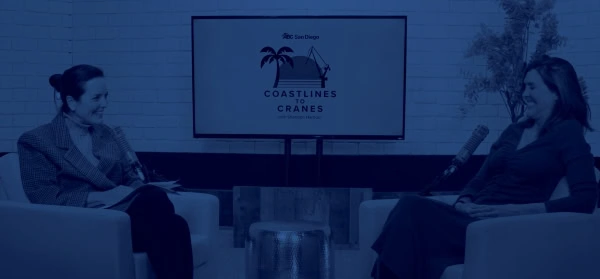
Good morning, San Diego. Welcome to Coastlines to Cranes. I'm your host, Shandon Harbour. Here we dive into the stories, the people, and the choices that shape construction and beyond. From the shoreline to the skyline, this is where the real work meets the real talk. Just a quick shout-out to our amazing new Track 1 studio. Matthew here. We are very professional nowadays. You all will notice a big difference in the sound quality. Thank you, Matthew. This is an incredible studio location. Also, I'd like to give a big shout-out to Emily, our new marketing coordinator, who has taken over the podcast and all the programming.
She's taken over where Jillian, our intern, has gone back to school. Thanks, Emily. Thanks, Matthew. This show is headed for the big time now with you guys behind it. All right. So today's episode talks about from Y2K to AI. Here's why. Back in the olden days, there were a lot of us that were very scared about Y2K. The stage was December 31st, 1999. And for those of you that are old enough to remember, these were the days when we all thought that our computers were going to roll over and they would not be able to handle it because it was going to hit 2,000.
ATMs were going to eat our bank cards. Planes were going to fall out of the sky. And everything was going to turn into total chaos on that New Year's Eve. It was absolute panic for so many people that they thought the robots and the computers would not be able to handle the turnover. And it got so crazy that people were storing huge barrels of water in their garage and they had prepared for nearly what was perceived as Armageddon or the coming of the end. I compare that to somewhat of the panic that's happening right now around AI.
And I'll get into that in a little bit. But let me tell you what actually happened on December 31st, 1999, because I was there. It was that moment that a lot of us were singing the Prince song, 1999, because that was what we grew up with. It was an amazing song. It was New Year's Eve and the fireworks were happening and we were all thinking, OK, what happens next? Is this it? And no, we just kept partying. It kept going all the way until the wee hours of the morning. I can't tell you what actually did happen to me, though.
I got a call from the police department and my brothers were having a huge New Year's Eve party at my parents' house. They were out of town and they decided to fire up a rump roast on the barbecue. Alcohol might have been involved and set off the fire alarms. So the fire department was dispatched and I got a call, said, come on up to the house. We have an issue here. So, yes, not quite the explosion that everyone expected on that New Year's Eve, a different explosion of sorts, I guess you could say. But really, the reason was there were a lot of people and engineers behind the scenes at Y2K, years in advance, programmed and made sure that there were coding patches and testing systems and nothing collapsed.
Planes landed. Banks continued to stay open and construction projects kept on moving. So, how does that compare to what we're dealing with right now with AI? Well, I see the same sort of panic happening. In fact, last weekend, the headlines in my email, one of them said the godfather that founded AI said it's the beginning of the end of the world, essentially, that we've created a monster. And in a number of years, AI is going to take over and that's all that we're going to know about. And the other headline was chatbots can go into a delusional spiral.
And I thought, wow, we have really picked up the panic on this AI situation. I have members out there telling me that they are resisting AI. There are a lot of folks that feel that construction jobs are at risk here with AI. People are talking about robots taking over the industry, that they'll no longer need construction, individuals, humans on the job sites. And to that, I say, no, I don't see AI taking over our construction jobs. And the reason for that is that you still need a human element, a discernment on the job sites. And AI can't build trust and culture in your workplace.
What AI can do is that it can eliminate a lot of busy work, a lot of administrivia, stuff that I call scut work or things that are really bogging us down to do the more creative things in life and make us more efficient. And that's where I see AI having a huge impact on this industry. So this is nothing to be concerned about or worried about. Now, the other great thing about AI and the impact that it's having on construction is that it is driving the Generation Z to our industry, because this is a very sophisticated generation, as I've mentioned in previous episodes, that they are identifying the jobs that could be impacted by AI and choosing careers that they see will most likely not be impacted by AI.
So it's driving quite a few of these Generation Z folks into the skilled trades, which is us, construction. So we're seeing an uptick in interest in the Gen Z because they're saying, hey, we don't want to have a career that's going to be impacted by AI. We want a career that's going to be something that lasts for my life. And so the skilled trades is one of them. And that, I think, is a benefit to what we see happening in AI right now. So the lesson learned here is that preparation for AI, preparation for Y2K helps mitigate some of the panic.
And so those of you that are concerned about AI or have a fear of dabbling in AI, really should look at it closer and see how it can impact and improve efficiencies in your business. Just a quick story, again, about how AI has impacted my world. A few months ago, we were in the hospital and my husband's brother had suffered a heart attack. He was in the ICU. A lot of the doctors came around and were asking and talking to us about stabilizing him and what next steps were. But they spoke in medical speak. And for any of you who have had any loved ones in the hospital in a serious condition, there's a lot of medical speak.
They're very calm. You're not really understanding what's happening. I really desperately wanted to understand, at a very simplistic level, what was the prognosis for my brother-in-law. And so I had heard from my kids and my son, who's 21 at San Diego State, talking about ChatGBT and how he used it all the time. And he had actually told me, hey, mom, you know, you talk about being born before Google. And he said, I'm going to tell my kids I was born before AI. I laughed. Anyway, I went to this thing called ChatGBT and I asked it to tell me in fifth grade terms what these medical terms were and what what did the doctors mean with how my brother-in-law's condition was.
And it instantly gave me relatable information that I could process and make decisions on in a matter of seconds. And I shared it with my husband. And we then began to ask it quite a few questions. From there, I realized, oh, there's a limit on how many questions you can ask. And so I purchased the subscription version and became hooked. That's how we got through dealing with his brother-in-law in the hospital and all the myriads of things that happen. Fast forward, I now have a subscription for all of our staff members at ABC San Diego so that they can receive the benefits of utilizing AI with their day-to-day work.
For example, we've been uploading a lot of information into our subscription services through ChatGBT. And then another staff member can ask it a question and it will give responses quickly. It's very efficient. It's very effective. We've really opened up an entire new world. We're exponentially more efficient and more productive. And we're really able to focus on things that give us the ability to be creative and build and grow. So any of you out there in the construction industry that are contemplating this AI, artificial intelligence, I strongly encourage you to investigate, research it, call ABC. We have resources to help you get started on it.
And we also have lots of companies that will feature on this future podcasts to talk about how you can bring AI into your business. So bottom line, folks, panic sells headlines. Preparation builds resilience. Don't always believe the negative. The positive things that are happening with AI out there are so much more beneficial. And it's the people on how we choose to use it. So that's the key. It's the people part.
Anyway, next up on Coastlines to Cranes, we're going to be talking about mental health and construction. We have quite a few resources available at ABC San Diego. And there's a lot to talk about. September is Mental Health Month. We'd like to feature mental health and talk about it more in our next episode. Thanks for listening this Wednesday morning, 6 a.m. If you love it, hit subscribe. Read the show notes. More information there. Give us a comment. Give us a shout out. Let us know what you want to hear. Until then, stay classy, San Diego.