Transcript
Good morning, San Diego. Welcome back to Signature Series, My Outside Voice, aka Hot Takes. So this is a Signature Series where I say what's on my mind. Today, we are going to talk about the merit shop. The merit shop is actually a term that ABC, the Associated Builders and Contractors, have termed and coined, meaning it is a formal way of building where hard work pays off. And what that means specifically is if you go to work and you earn a solid day's pay and you perform and you've got a great work ethic, your efforts will be rewarded by merit, which means you will excel based on how hard you work or how much you put into it or your attitude.
You know, it was great. I heard Steve Fisher speak one time at Downtown Rotary 33 and he had a very great thing that I actually, I always have a notebook and a pen and I always keep it in my purse. But that particular day, I did not have it. And I had only Post-its and a Sharpie, go figure. And so I pulled out my Post-it and I had my Sharpie and he said to the crowd, you know, I will hire on attitude all day long. He was talking about the San Diego State-based basketball team. He's like, I will hire on attitude and effort all day long.
Because you know what? There's only two things in life that you can control. And that's your attitude and your effort. And I wrote that down on the Post-it note. I said, there's only two things in life you can control. That's your attitude and your effort. And I put it up on a refrigerator for our family to see. And now it's framed. It sits on this scribbly Post-it note in our house. And so your attitude and your effort, when it comes to Merit Shop, really matter. Because if you've got a great attitude and you've got great effort, we can train on skill and technique and all the rest of the stuff.
But you will excel based on your attitude and your effort. And so that's not always the case with some of our competition. Some of it becomes accelerating by seniority only. And what that creates is that the folks that are actually working hard and trying to excel, they get frustrated. In fact, Jim Collins in Good to Great wrote a lot about it as well. He said, you know, if you've got A performers, but you're rewarding everybody equally across the board, and you're, you know, B and C performers or D performers are getting the same rates of increases or the same rates of attention and performance evaluations as your A performers.
You will lose your A performers to another company. Why? Because they want to go to a place where their hard work is recognized. And that brings us to the Merit Shop. Merit Shop companies recognize A performers for a job well done. And so the philosophy is very noble because you want to reward your A performers. You want people to succeed based on their merits of their work. You want people who have a great attitude and a great effort to accelerate in your companies. And so what that means for competition is the companies that are performing based on merit tend to do things faster, more productive.
Employees are more engaged. There's a lot of times where opportunities are given to employees that have a great attitude and great effort. They're expanded in their ability to do different things. And so they're able to do innovative things, which leads to employee engagement. I've heard employees from different companies talk about, you know, I love working for this company that's one of our members because they're really innovative and they let me try new things. And I'm not just regulated to doing one thing, turn a widget all day long, same widget, same widget, same widget. I'm able to explore new routes because they're looking at me saying, yeah, why don't you try that?
So if Merit Shop is such a fantastic and noble way to lead your business, why is it such that the narrative out there that we're not safe or we hear things like we're not professional companies, that's absolutely not true. And here's the cool thing about it. We've got a study that's coming out. It's the first of its kind. It's all about multi-skilling. The Associated Builders and Contractors at the national level has procured a group called the Simplar. And so it's called the Simplar Study with Multi-Skilling. And where this comes into play is there's never been anything like it ever done before.
Anything like any of its kind where actual, you know, nonpartisan research has been applied. There's three different universities involved. And they've gone out and researched hours and hours and hours and hours of what this looks like when you're cross-skilling, you're cross-training your employees so that I'm not just doing one or two things, I'm doing a few things or I'm able to do, you know, if I'm welding, I'm doing welding, but then I might be able to help out somebody with something else on the job site. It's called multi-skilling your workforce, innovative, merit-driven. And the study has actually come out to reveal fantastic things.
It's saying it's far more efficient to be cross-skilling your workforce because you don't have to wait for somebody to come and just do one particular thing. In the union model, it's called jurisdictions and it's jurisdictional issues because if I'm an electrician or I'm a laborer, I'm only allowed to do X part of my job before it crosses into another trade. Well, if you're working on a job site and you have to wait for the other trade to show up to complete the project, what does that look like for your project management schedule? Are you waiting days, hours?
You know, what does that look like as far as scheduling, making sure things are staying on a timely basis? Whereas if you have somebody that could cross into different jurisdictional issues, in a merit shop, we don't call it jurisdictions, but if you're cross-skilled, then you have somebody that's able to do a little of something of both and you're not waiting and you're not, your project schedule can move forward more efficiently. So the research is fascinating. It not only says that it's more productive and more efficient, but it says that there's a higher employee engagement related to that because, as I've mentioned, employees get to learn new things.
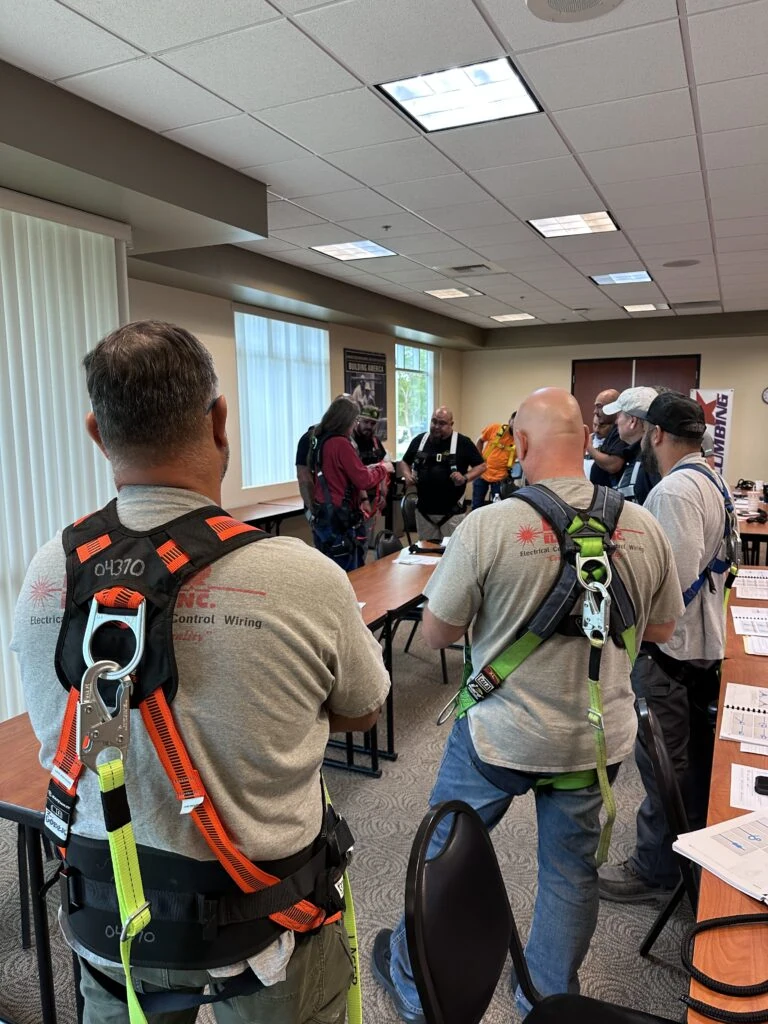
You're training them on different things and new and innovative things. It also found that we're safer amongst all things, that part of the cross-training is that we instill a baseline of safety that has come out as a sub-proponent or a subcategory of the multi-skilling, that out of the research that merit shop folks not only are safe as, but safer, and that of the Bureau of Labor Statistics. So that means that, hey, we're cross-training and we're making sure that we're sending all of our employees home safely at night because that's the number one thing. Absolutely, bar none, we want to make sure jobs get done in a safe manner and our workers go home to their families every single day above anything else.
It's always about safety. So the study and the research has proven that multi-skilling is safer, it's more efficient, it's more innovative, and it's the Merit Shop way. We're rewarding for great performance for your attitude and for your effort. And I know for myself, even working with my team at ABC San Diego, I'm always looking for attitude and effort. We have a great, great culture. We are, have been recognized as one of the best places to work in San Diego.
So that goes to the great team that we have at ABC San Diego, but also making sure that it's driven by attitude and effort. And those that perform and those that work hard and have a great work ethic and have a great attitude and put forth the effort, they're rewarded for that. The last thing I'll say about Merit Shop and one of the great beliefs in Merit Shop and capitalism is, that's slightly different from the other ways, is once you get to a certain point, if you want to start off your own business and go out and what we'll say, hang your own shingle and become your own business owner, and you've been an pediatrician, you've come out of our apprenticeship program and you've become a journeyman, that is fantastic.
There's no greater thing than being a job creator for other people. There's so many stories that I have where I've got a journeyman. I've watched them go through the program. They've become a journeyman. They were working for a company and they come up to me and say, hey, Shandon, I want to talk to you about different things with ABC. I'm either thinking they want to be an instructor or, you know, maybe they want to talk to me about classes or something like that. And they say to me, no, I want to talk about becoming a member.
And I was like, wait, what? Did you start your own business? And they're like, yeah, I've started my own business and I'm, you know, we're getting going and we've been in business for a year or two now and we want to become a member because we're broadening our horizons and we're going to start hiring apprentices. That is the greatest joy for me because this person or this individual, I mean, big risk, went out there and started their own business, looking at creating jobs for other people, creating other opportunities. Again, the Merit Shop way is go out there and make it happen.
It's all about your attitude and your effort. And when they come back and they say, hey, I want to join ABC and become my own member, no greater satisfaction. It's amazing. It's seeing, you know, America and in actual real time, it's, it's happening, changing lives from the apprenticeship program, getting into the trades, becoming their own business owner. It's, it's really coming home full circle for me too, because, you know, I came from college family and the trades were always an option, but it was one of those things where I never really thought about it, especially growing up.
I didn't even know about the trades program really that much. Now I have a nephew who has just joined our program and he came down from Oregon and he's rooming with my, my son who just graduated from college and started his job on Monday. He's getting going. And if you ask him like, what do you want to do? You know, what is it? What do you, and he's super excited to be in the program, but he, he's like, I'm going to start my own company someday. And that is exciting. You know, he's going to go through the program and he's going to be out there.
And I think the fabric of America is small, mid-sized contractors that are making it happen, especially in San Diego. We're small, mid-sized companies, we're bakeries, we're trades people. Go down the freeway, you'll see all the different contractor trucks on the freeway, your, your cosmetologists, your, you know, I know friends, daughters started their own hair salons. That is the fabric of America. And that is some of the great exciting things and the things that keep me going and, and get me excited when I wake up every morning. So my, uh, outside voice, my thoughts today are merit shop.
It's a noble way. It's, it's proven that it's efficient. And I'll leave you with the same thing that Steve Fisher told me for the whole world out there and, and anybody out there and doing their thing. It's all about your attitude and your effort. Go Aztecs. And you know how we end every episode. Stay classy, San Diego.