Transcript
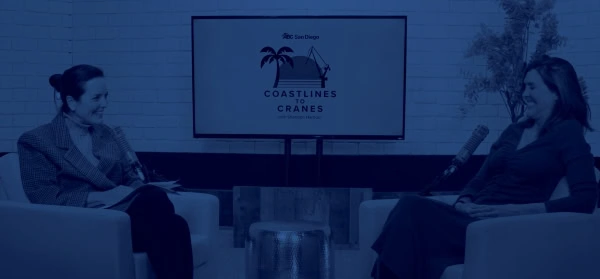
Good morning, San Diego. Welcome back to the Signature Series, My Outside Voice. This is what I say when it's my outside voice and I say something out loud like, blah, blah, blah. And then people go, look at me weird. And they go, oh, I go, oh, sorry, that was my outside voice. So today's generation is, they're calling it the hot takes. So I guess, you know, my outside voice is hot takes in today's lingo. So a little bit about today's episode. You might notice my feathery outfit was inspired by the team here at the studio because they were like, oh, you know, you look professional.
I was like, oh, getting ready for today's podcast. I said, ah, what can I wear? So now not only do you get my outside voice, but you get my outside voice dressed in fashion. So keep up with the podcast and see what kind of new outfit I'm going to wear for the next one. All right. So what is on my thought brain and what is my outside voice for this episode? With everything going on right now with the Fauci hearings, it's really throwing me back to the days of COVID. So I don't know if any of you are out there watching or listening to what's happening with the Fauci hearings.
But it is reminding me of that journey that we were on together as a society during those days, during the pandemic. And I just thought I would share the journey that we were on at the apprenticeship program. And interestingly enough, I hope that some of the decisions I made can't roll back to get me now because they were definitely on the edge and I had to use my gut and kind of push forward and do what I thought was the best and what was right for our program and for our students. So interesting. I went back to my car, too, because I still have it, that the date of this letter was April 3rd, 2020.
And for those of you that lived through it here in California, we had to have notes in our car that basically excused us to be on the road. And so this letter says basically that in response to COVID-19, the following listed individual is an employee of Associated Builders and Contractors and is considered an essential worker under this executive order. So I had to bring my name and it says our standard business hours, here it is, this is the letter that is still in my glove box. So I had to bring it because it throws us back to the time when everything was shutting down.
The day was March 15th, if I can remember off the top of my head. It was going into St. Patrick's Day weekend and my stepson, bonus son, Luke, lives up in L.A., had said, hey, his bars were shutting down for the weekend. And I thought, OK, it's getting serious. If the bars are shutting down over St. Patrick's Day weekend, this is getting serious. And it was a little bit of a canary in the coal mine for the rest of us because I thought, OK, we're still going to school. We're still, you know, all our students are on deck.
We're all going. We knew a little bit of what was happening because we had started doing safety briefings. We started sort of wiping down the mail. This is in the time frame of all of us, you know, wiping down things before they came in the building, almost like they had a coating on them. We would spray things down. And that Monday, our board and everybody started talking about, you know, should we be pivoting to online school? What are the thoughts? How fast can we do this? And around that same time, the governor then started shutting down the schools.
And that's when we all started moving to online. And I think the exact thing happened was we moved all of the schools to like an accelerated spring break and kind of gave us a moment to figure things out before we actually were able to put everybody back online a week later. The interesting part was that we did not go remote for our business, for the association. All of the employees, all of us, we kept coming back. And there was a reason for that. I was very adamant about making sure everybody continued to come back to work.
We didn't have a closure with the association because we were considered an essential function. Per the guidelines, we were construction. So we were able to continue to come back. And it was still in the – and I was talking to the other associations. We were all coming back. It was still a little bit of the, you know, wild, wild west. We didn't know exactly. We didn't have masking yet. So this is a moment in time when all the associations were getting on calls almost daily, if I can remember that. And it didn't matter if you were union, non-union, whatever it was.
All – what we'll say – all epaulets are off, you know, in military terms. Like, you don't have any rank in these meetings. Everyone was just there to figure out what the afternoon would look like, much less what the morning looked like because the morning there would be sort of a regulatory rollout from local or municipal government or state government. And then the afternoon would have another rollout. So we were constantly on the phone trying to figure out what are you guys doing on job sites? How are you communicating with your members? How are you dealing with your schools?
So I'm sharing all this background knowledge because we lived through it. Now, we didn't have masks. What we said was we're going to use handkerchiefs. I don't know if you remember that time during COVID. We started supplying bandanas to all of our members. They could drive by our office, and we would hand out backpacks. And in the backpacks was hand sanitizer, toilet paper, bandanas, updates, anything we could do to support our members in construction who had to get people out to the job sites in a world that was shutting down. It was also right around the time that the stores were, you know, the shelves were being cleared out.
Toilet paper rolls were going like crazy. Costco kept saying, we will continue to stock toilet paper. And yet we, you know, like crazy, it would vanish in a day.
And that's the sort of day-to-day where we weren't sure what we were doing. Then as time went on, as we know, we all lived through it, that there were more sort of structures in place. OSHA came out with regulatory recommendations.
The vaccination hadn't come out yet, but then we had the masking. We had the masking inside, the masking outside, inside, outside, whatever. Keep in mind, the entire time, construction is still going. Our schools are still going. We have to bring them in for labs because you cannot have students out on job sites and be unsafe and not familiar with what they were doing. So in order to have lab, we had the temperature. We had the, you know, people at the gate temp swabbing. And we had hired special tool sanitizers. And it was so funny because I was like, okay, whenever they touch a tool, we have to have, it was like a helper would come along and wash their tools for them.
And then they would get their tools back. We had these stations all over the lab because we could only have a certain amount of people. We had big tents in the back of our parking lot. And we had called the Poway mayor and said, you know, sir, Steve Voss, hey, these tents are not party tents. We are running our labs. They're outside. Nobody's close. We're six feet apart. We're sanitizing tools. We're taking temperature. We're taking tests every time we, you know, have a symptom. He's like, construction's essential. Carry on, my friend. So we carried on.
Here's where it started getting very interesting and why these hearings are really fascinating to me. There came a point in time when we were either required to vaccinate everybody or everybody was masking or, you know, everybody had to go home. And I would make some decisions to say, no, we're not going to require the vaccine. And we're going to mask when appropriate. And we're not shutting down. And I will tell you, there were times where my heart was pounding in my chest because I thought, I hope I'm making the right decision. I hope I'm making the right decision.
But I was making sure, first and foremost, everyone was safe. And our safety measures were the top. We were extraordinarily safe. And I wanted to make sure I honored some choices by the apprentices on whether or not they wanted to vaccinate or not. And I really believe strongly that for people that had been through the program after four years, where they said, if you make me get the vaccination, I'm going to quit. I was like, you're not quitting. You put too much into your profession. You put too much into your career. We're not going to require you to vaccinate.
We're going to get through this.
And I would look at the numbers and I would look at, you know, we'd run numbers every single day, how many people were coming down with the symptoms, how many people were out versus how many students. And we would look at percentages. And the percentages were extraordinarily low. And so what I was seeing from a county of San Diego standpoint, because they would also produce their numbers daily. I was on a phone call daily with the county. We were seeing very low numbers. And so I really felt confident that the decisions that we were making were safe.
We were taking consideration the human, the students, the population, the school and everything else. And we were OK to continue moving forward as we were doing so. And so here we go. Fast forward. It was years. I think it was 18 months to two years or we're nearly shut down. But we started reopening again. And I think there was a moment in time, I heard it on the news last night, that we were shut down, opened and then shut down again. So we went through that, all of those, consistently keeping our program open, consistently keeping it where it was a choice for vaccinations.
And when we had graduation, I want to say in 2021, we continued to have graduations, I should say. We did the drive-through graduations that a lot of high schools did. We did it in our back parking lot where, you know, we stood on a stage and we had them drive their cars by. And we tried to make the most of what was a very difficult situation. However, when we actually had our graduation in person with the, you know, first full back to a reception or a crowded room graduation, I had a student come up to me and say, you know, thank goodness for you and keeping the road, you know, keeping staying on the road.
Because had we required certain things or had we shut down, his life would have taken a very different turn. And he said, because of you, we were able to get through it. And I was able to graduate. And here I am, you know, carrying on with my life. And I didn't have to start the program over again. And it wasn't me. So I want to make sure it wasn't me. It was a team. It was one of those things where we were all making decisions.
And I did take responsibility that if anything blew back on us, I was the one that was going to take the fall for any bad decisions. But collectively, the team believed in the vision and the direction that we were headed. And we got through it. And I think one of the other things, too, is when people say, well, what, you know, what were you thinking?
And it was tough. I will say there was a lot of times where people were dealing with a lot of struggles mentally because they were at home isolated. There were a lot of people that were, you know, a lot of day drinking going on, a lot of joking about day drinking. But it was happening. And I'd come home and tell my husband, oh, my gosh, I mean, am I doing the right thing? I am not sure. There's a lot of news out there. It's crazy. And he said, you know, routine gives us purpose. And I will never forget that.
And so every day I'd get up and I'd get to the office early and everybody would come into the office. And we kept our distances and we had all the appropriate things. But routine gave us purpose. And our team did so well through that multi-year pandemic where I would say others struggled greatly because they were isolated and they didn't have the camaraderie. They didn't have the teamwork. They didn't have, you know, all the things that were happening. And so, you know, listening to the Fauci hearings and some of the discussions that are happening, it throws me back to that moment in time where you just are hoping you're making the right decisions and you're believing in people and we're all going through it together.
But sometimes you do have to make decisions that are not what the norms are. And so when I said, you know, vaccinations are optional and we're going to continue to gather and do labs, but we're going to do it safely. Those were some pivotal things. And it was a pretty amazing time. I would have to say probably looking back in my era of leadership might be the most pivotal thing that I experienced as a leader, other than the couple of recessions that I'm living through, one of them being a little soft right now. But that I think was pretty remarkable.
So, you know, for those of you that are listening right now to the Fauci hearings and you're listening to this podcast, I'd love to hear your comments. What were you doing on April 3rd, 2020? Or for some of you, it was March 15th, 2020. What were you doing in 2021, 2022? I mean, I think it went all the way through that we were still just coming out a little bit in the last years of 2022. Give us your thoughts. We'd love to hear comments. We want to engage with you. This is my outside voice. And thanks for listening.
You know, give us a like, subscribe. Stay classy, San Diego. Thank you.