Transcript
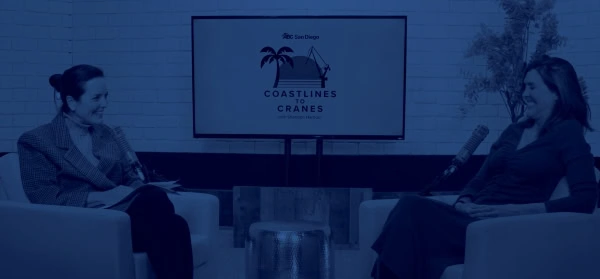
Good morning, San Diego. Welcome to Coastlines to Cranes, another episode where we bring you the people, the culture, and everything around the construction industry. We are the original podcast in San Diego, ABC's podcast, Coastlines to Cranes. In this episode, we are delighted to bring back, fan favorite, the Earl the Pearl, the Fighting Pearl, to our video episode. You might remember him from one of the first episodes that we had, and then came back for a second, and we've asked him to come back for a third encore. So welcome back to the studio, Pearl. As they say in the ready room, damn glad to be here, boss.
There you go. Yeah. So, I mean, we'll kick it off by saying when we launched this episode or the podcast last year in July, actually about a year ago right now. This might actually be, we're going to look it up. I bet the episode that was the annual episode that kicked it off, and you will remember it well. It was Jillian and I kind of jimmy rigging something in my office. We thought, oh, we're just going to do this podcast. She was an intern. We said, oh, we're going to get it going. It's not going to take that much work.
We're just going to roll. And she was an intern. I was all about it. And we had these janky microphones. And she said, you know, Shandon, just do it by yourself. Just talk. And I said, I can't, I can't do this by myself. I need to talk to somebody. So I called you. I was like, babe, come over. I need you to be on the podcast. I think I was dropping off your lunch and I got, I got voluntold to come in here and sit down and talk. Try to sound intelligent. Might have been. And we were talking about the history of the cowbell, which we have right here.
And then they told us our mics were terrible. So they sent us off to a sound studio. And I again called you and I was like, okay, we're testing out the sound studio. You got to come on the podcast again. Got to tell more stories, military and construction. We got a lot of similarities. And, uh, since then we've rolled over to video and I said, oh, you got to come see the studio, babe. You got to be on the show. So welcome. Well, I had to know that not only am I easy, I'm available and I'm cheap.
Hey, dad said to be cheap and easy, but not both. That's right. Oh, lots of jokes on this show. Okay. So here's the big thing. You know, people see you hanging around ABC. They, they're like, you know, what, what's Pearl's deal? Um, what does he do? Is he got a day job? What, what's your interest? And you know, you come to the conferences. Yeah. You're a little bit about that. Obviously my number one purpose there is to support you as my wife. Uh, we make a great team. And, um, so as we go to the conferences, we've been traveling an awful lot this year.
Um, I enjoy one going to the conferences, you know, the, my two most favorite people in the world are Marines and construction guys. They're very similar. They are. Um, ready room humor, ready room humor is very similar. They work hard. They play hard. I can attest to that. Um, it's, it's a, it's a really good group of guys. So number one, I enjoy it. Uh, number two, I also learn a lot. Uh, I'd like to hear what the latest and greatest is in the, during the construction industry. Um, and then how can I apply that in my own circle of influence with, uh, the San Diego military advisory council, uh, or the Marine Corps Aviation Association.
You'd be surprised what, what, uh, cross, uh, crosses over. Um, and you know, when you go to these conferences, um, uh, inevitably in that, not only in the construction conferences, but in just about any business industry conference, uh, there'll be at least one, one of the presentations will be some leadership guru, some leadership coach, and he'll give some really fancy 57 slide deck thing on what it takes to be a good leader. Inevitably, most of them are just really fancy slides. And you get out of the 57 slides, you get 56 quotes. And, and, uh, you know, quote, aim for the stars, aim for the stars, good leaders eat last.
And, uh, don't forget to floss your teeth and a good leader is vulnerable. And, uh, that's okay. Uh, and, and after the presentation, what will happen is we'll be sitting in the back taking a break and some of the guys will come up to me and they'll go, Hey Pearl, what'd you, what'd you think of that? Yeah. And, uh, um, you know, based on my experience, I'll give them an honest opinion. And most of the time, yeah, they're okay. I mean, it's eight ways. None of the, none of the things he said was wrong, but the real hard part is to take those concepts and those quotes and those theories and apply it to your situation.
And if you have a coach, if you're working with a coach or you're working with some sort of a leadership guru, if he does not help you, uh, with your personality in your business environment, with your audience, your employees, or your customers, as you make AB, he's got to make it work. And the case in point is you can't, uh, you can't be the drill Sergeant coming into a group of Gen Z's. It just, it will not work. It's not going to be very effective. So, and by that, I mean, yeah, you, you bring out the strengths in your personality against the challenges of that particular business environment and the challenges and the pluses and minuses and the strengths and weaknesses of your employees.
Um, and that's how you wind all that stuff together so that what works, you know, in the plumbing industry may not work in the electrical industry, it may not work in the office. And that's, that's the real key is to find that, that works. Now, yes, there are some characteristics that, um, that transcend and they, yes, the characteristics or traits that apply just about all the situations. Um, but not all of them. And I think that's what's important. And so what I share with them is to say, um, take a look at, again, your strengths, your individual personality strengths, uh, take a look at the strengths and weaknesses of your employees, and then take a look at the peculiar challenge of the business environment.
And now you have to kind of line all that up and it's, it's not easy, but I think, um, uh, it's very doable. And I think that most of the guys that I've seen are quality enough to be able to do that. Um, so anyway, the bottom line is it's a lot of fun. And I, I get to go, uh, you know, these really cool places, uh, but I get stuck in a hotel room all day working on your stuff. Like Shandy Awards. Yes. But don't tell it. We're not supposed to tell anybody that on the podcast or whatever.
We want to keep that to ourselves. No, I mean, I, I'm listening to you think, okay, so you play to the strengths and weaknesses. And as a team, you see my weaknesses are the fact that I'm all big energy and, uh, uh, maybe tight details are not my strongest suit. So you come to the conferences and you make sure I get there on time. You're making sure, you know, all my bags are checked in. I'm, I'm talking to the sky cap, like, Oh, Fred, it's so great to see you. Oh my gosh. How have you been?
And I've left my bag there on the, get your boarding pass and we forget our baggage. Right. So that's how we make a great team. But I mean, the same is true when I go to your conferences or there's an event that, you know, you're the lead. And so I think a little bit of fighter pilot education has come in our relationship where it's like, Hey, I have the lead or who has the lead and who's the wingman. And, um, you know, we make a great team that way that we understand each other. And, you know, just for the record, everyone knows it's not our first rodeo.
This was a second marriage, but some of the lessons learned on our first attempt on my picker was off. I'll say that, but, you know, uh, have been that, Hey, we listen, we need to compliment, compliment and supplement whenever that happened. You know, I think that's important to understand. So if you're, if you're a business owner, you really do need a good, uh, number two. Um, and that's how it works with us. And if it's your conference, I know I'm the wingman. And if it's my conference, you know, you're the wingman, but I will say, uh, and, and you have to exploit that number two strength because if you walk into a room and go, hi, you know, like that, everybody loves you and they want to talk to you.
If I walk into a room and go, hi, I get thrown out. So there's things that you can do that I just can't do. Yeah, exactly. Yeah, no, I mean, I think that's one of the, the great things that we wanted to talk about on this podcast is the fact that we, we do make a great team in business. You need a great team. You need a great support structure. Uh, we talk about starting businesses in, in contracting. A lot of times people will go out and be an electrician and then start their own electrical business.
You need a good home front family support and same for the military. So if you're on the military side, I'm on the construction side in the military. It's so important to have that strong number two, um, supporting you. And you could talk more to that too. And I think it's important because you, you have to, at some point you're going to have to take some time off. I don't care who you are. I don't care how strong you are. At some point, you're going to have to take some time off, whether it's intentional or unintentional, it's an emergency.
And you want to be able to look at that number two and literally do the handoff. Like I got to go, you got it. Um, and if you can't do that in your business, you really need to ask yourself, why not? You know, is it because I don't trust them or I don't have a good enough person? Uh, and then, uh, on the opposite side, you, you use that person as a sounding board. And, but I think it works both down and up, uh, in command. I would make sure that my squadron commanders would use my, we call them the executive officer and say, look, bounce the ideas off him first.
And, and before you come to me, uh, and then vice versa, I would bounce things off him to make sure they made sense. And then, and then I listened to him and it doesn't mean that I'm bound to follow his advice, but you certainly want to listen to him, you know, cause they kind of like your wife, she knows you better than anybody. And I know you better than anybody. Um, and that's, I think you take that same concept and apply it to business. And then what you'll find is that leadership stuff really starts to happen because if you can take care of that number two, then you got to learn how to take care of your people.
If you don't take care of them, they're not going to take care of you. Oops. Is that a quote? Yeah. There you go. So not only is number two important at home, but also in the business, making sure you've got a strong number two in both places, wingman, if you will. So we have to talk a little bit about the cowbell because so much of San Diego's culture has become this cowbell. You were there and, uh, it was Swanee who's now a deputy commandant of aviation, right? Deputy commandant of aviation. And you were just recently at a MCA event this year, earlier in May and saying he's still doing the cowbell.
He's still doing it. So talk about that. This is the, this is the cowbell from Swanee. Yeah. That's the one from 2017 when he was a commander here at Miramar. Um, I've known him for a long time. He used to work for me. Uh, we flew together in Iraq. Um, he's now a three star. He's a deputy commandant for aviation. So he's the senior aviator in the Marine Corps. And at this last adventure talking about, we had a, uh, Marine aviation symposium in Dallas and, uh, he brought his cowbell and he gives them out much like some guys give coins, you know, the memorative coins, their challenge coins.
Uh, he gives them out, uh, to his high performance folks. Uh, even the, uh, the, uh, the new master ceremonies, uh, he's actually had a tough time, but Swanee wanted to kind of beef him up a little bit. And so he said, Hey, I'm going to give you a cowbell. Uh, so yes, it's still alive and well. And, uh, and, uh, and it's funny because when he gets some of the heckling from the audience, the, the Marines back him up a hundred percent, you know, they, I mean, they love the cowbell. It's just, it's really, it's really fun.
I think this cowbell is technically yours. Cause Swanee gave it to you because you're a former CEO of mag 11. I'm telling Swanee, I want my own cowbell. Okay. Swanee, if you're watching the podcast, I want my own. Um, but you mentioned something Pearl about MC and, you know, gave the master of ceremonies. So I know, and your long history with, um, the MCAA events, you were 20 years. Yeah. And, uh, you've got the SD Mac achievement awards coming up and they have asked you to be their master. So ceremonies again, two questions on that one.
What does it take to be a master of ceremonies? Clearly you're really good at it for a 20 year streak and people are continuing to ask you to be their MC.
What does it take? And the other question is, how do you get away with all of those edgy jokes? You try them on me and I'm like, definitely not like, no, you cannot say that out loud. And then you'll be like, I said it. I'm like, what do you said it? And then you were like the crowd went wild. So what does it take? And how do you, um, number one, a good sense of humor. And it realized that, uh, it, the, it's okay to place jokes or tell jokes about people. But if it comes back to you, you're the fall guy.
You know, the, the standard is somebody you make a joke about somebody and he goes, Oh, you too. And you go, Oh, I, I stand in the shadow of your greatness. And you just let it roll off. Cause it's, uh, the, the purpose is for, in my opinion, the MC keeps things moving, but he also makes sure that the people, uh, enjoy the time that they're there. And the best way to do that is through audience engagement. And the best way to, in my opinion, do that is through, uh, humor. And, you know, uh, you got to pick your audience.
You have to pick the receiver of the joke to make sure that they appreciate the humor. Um, and then, and it takes a lot of work because in this case, with the, uh, uh, the SD Mac achievement awards that are coming up August 29th, if you want to go, you can register at sdmac.org. Don't miss it. Uh, at that point, we're going to recognize some of the best of the best, as far as the local sailors and Marines, you know, the Salem arena quarter for the different commands that are in the local area. We're also going to recognize the industry partner of the year, uh, the nonprofit of the year.
And then the, the, the final, uh, award is the SD Mac lifetime achievement award named after Bruce Bolin, who was one of the original, uh, SD Mac board of directors, well-known, uh, community, uh, activist, uh, uh, pro military guy in San Diego. Um, and you get to know them and you make the awards about them. You personalize it. You make sure the audience knows who it is. It's not just a little statue. It's the person that's receiving it. Um, and of course, if one of the senior officers comes up to present it, you can make a little fun, you know, give a little fun and make, break the ice.
Uh, so it's a lot of work. Um, and you do, uh, I usually look at the head table and I judge how the joke goes by how much teeth sucking is going on at the head table, you know? So I kind of do the, uh, okay, maybe a little too far. Right. Because people come up to me afterwards. They're like, the only person I know that can get away with that is Pearl. Like Pearl is the master at it. So yes, definitely got that. Okay. Pearl, before we wind up, everyone wants to know, give us a fighter pilot story.
Come on, do it. Tell us a good one. Got to use your hands. And you know, right before we get to that, how do you know when the date is halfway over or actually the podcast? When we say enough about me, let's talk about flying. Okay. Let's talk about flying. Uh, in, in, uh, in lieu of our, or in adjunction to our comment about a number two. So in the F-4, there was two, there was a pilot and the backseater is called a RIO radar intercept officer. So let's go back to September, 1981. First Lieutenant Wedderbrook, all of 26 years old, is a, is one of the youngest, uh, students at Top Gun.
Okay. And, uh, I'm on top of the world because this is the nexus of fighter pilot stuff. And I, there's, uh, eight crews there. We have four F-14 and four F-4 crews and I'm the youngest pilot. Um, so I'm kind of sitting in the back. Uh, and I finally get the opportunity to brief and lead one of the big events. Um, and my RIO was an older senior captain. His name is Ben Guipe, call sign Hyman. Uh,
It's okay. We're talking to the construction crowd. It remembers back in 1980s. All sign Hyman. Anyway, he was, uh, he was a bit of a Liberty risk. Um, and I went up, talked to him. I said, Hey, uh, let's, let's play it easy at the club tonight. This is really important to me. We've got a lot of work to do the briefs early in the morning. Uh, let's, let's take it easy. And he's like, ah, yeah, sure. Sure. We got it. We got it. Yeah. I remember like tell everybody that that club was like. Oh, the Miramar club back then was a combination of New York, Las Vegas, Sodom and Gomorrah.
Uh, you know, fighter pilot, a plus personalities, just oozing with testosterone and the best beautiful scenery of Southern California with big hair and tight. Uh, what's the word I'm looking for? Not revealing saran wrap. Uh, so it was a unique combination, um, of, uh, of fun, uh, anyway, so we, we go after the classes are over, we, we go to the club and about eight o'clock or so, I'm like, I'm done. And, uh, I go up to him. Hey, Hyman, you know, yeah, yeah, I got it. I got it. And I knew he'd already had a few cause his eyeballs are starting to get a little sparkly.
Um, so I said, okay, I got to go. Cause I got to prepare for this brief tomorrow. Remember it's early. We got to get up at five 30. Yeah. Yeah. Yeah. I got it. Got it. So I go back to my BOQ room, which is just across the parking lot. And I do all my prep. And by the time I've been ready to go to sleep, I look at my watch, you know, it's about 11 o'clock and I, his room is right next door to mine. We got an adjoining door. So I bang on a door.
There's no answer. There's no answer. It's like, damn it. So I went around the hallway, knocked on the front door, no answer. I said, well, I got to go to sleep. So I go to sleep and I've, I've got an ear open. You know, I kind of sleep a little fitfully, obviously, uh, uh, never hear him come in. And I wake up, alarm goes off about quarter to five. So I wake up five o'clock, shave, get dressed, bang on a door, nothing. Damn it. Walk around the front of the door, bang on his front door, bang on his, you know, Hyman, let's go, let's go.
It's nothing. I'm already stressed. How are you? And I'm just about ready to leave. And I turned down and the door opens down the hallway and here he comes stumbling in from an all nighter. And, and he is three sheets to the wind and his hat's off crooked and his suits all unbuttoned and, and Hey Pearl, what's going on? You know? And of course, I'm on him like an old granny. So I get him his room, get him a shower, get him a fresh flight suit because that one would have caught fire at the first spark.
Um, so we, I got it. I got it. We're all set. We're all set. So we get there, we get in a brief and I was like, all right, you don't do any talking. I'll do the talking. You just smile and nod. So we get through the brief, we get on the airplane and, and he's still recovering. Um, so we get in the airplane, take off, we go out and I'll be honest with you. It was probably the best flight we ever had. I mean, uh, the visibility in the F-4 is terrible. So we're fighting all these guys and looking around and, and Hyman in the back seat is just, it's amazing.
I mean, he's twisting around. I got this guy over here and I got this guy over here and we got this and he's, and I was, is amazing. Absolutely amazing. Perfect coordination. You couldn't have asked for anything better. You guys did well on that flight. The flight went extremely well. And which is important to me because I was a junior guy. I was leading this. So I had to, so we come back and back then you would land and you'd go through what they call the pits. It was a hot refuel. And that's where you take a moment to debrief before you got out of the airplane and went back to the ready room.
And so we're sitting in the pits, they hook up the hose and it takes about 10 or 15 minutes to refuel the airplane. And we're talking on the ICS. And I said, Hyman, I gotta, I gotta apologize. I mean, I was all over your butt, you know, and I go, that was probably the best flight we ever had. And all of a sudden in the back seat, I hear this, holy shit. And I'm like, what, what? You know, I'm thinking something's wrong. Something's wrong. He goes, Oh my God, I can't. Oh my God. I got, and I go, what?
And he goes, I never strapped in. So he never connected the harness to the seat. So he was basically just sitting loose in the seat, which explains how he was able to turn all the way around inside like a top.
We swore at that point, we go, okay, you, you can't, that's a safety violation. We'll get kicked out. Right. We'll never talk about this ever again, except on the podcast.
So again, that's the value of having, and that point I was the lead and he was the wingman, but then we reversed roles real quick and he was the lead. My job was to support him and we worked together and it worked out, but it was, uh, it was a very, very interesting flight. Are you clear from getting in trouble at this point? Because all your Marine buddies are listening to this. Are there any generals that you know, are they going to be able to like 45 years ago? So I think we've passed the, uh, the standards.
Okay. Cause we're gonna, we're gonna let this out to everybody and all, all the, all the higher ups. I'm sure all the deputy commandants of aviation, like Swanee will be like, you did what? Yep. Oh yeah. I'd hear about it.
Oh my gosh. Well, what a great story to end on. Anything else you want to share before we close out that we have to have you come back because we're, you know, we have a lot of material clearly to cover. I just, uh, uh, I will put a shout out for, uh, ABC San Diego. They were just nominated for, uh, one of the best places to work in San Diego. Uh, and I made a little comment, you know, it's ABC San Diego is an awesome team. You got a great group of people. Uh, and from what I've seen, they, they all work together.
It's very, very efficient, very effective, and it's a dedicated team to building the people that build San Diego. So congratulations to you and your team at ABC San Diego for the nomination. We'll be rooting for you. Yes. You know, um, well, we make a great team. All right. That is it for this episode of coastlines to cranes. Got to sign off before I start crying. Um, thank you Pearl for being on our show and, uh, lots of good takeaways, leadership lessons, how to work as a team and a marriage. And of course you can't ever sign off without having a great story from a fighter pilot.
Right. Now that we've talked about you, right? Now that we've talked about you and we've talked about flying, I guess this date is over. All right, San Diego. If you like this episode, give us a like, give us your comments. We want to hear from you and you know how we always sign off. Stay classy, San Diego.