Transcript
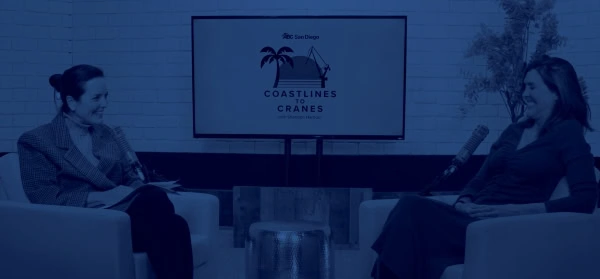
Good morning, San Diego. Welcome back to Coastlines to Cranes, where we dive into the stories, strategies, and sparks that shape the construction industry and beyond. My name is Shandon Harbour. I'm your host today. And today we are joined by Lisa Norquist of Gray Monkey Group. She is the expert in people, the people side of leadership and organizational development. And we're going to talk about the things that are the practical strategies that you could put into play right away, whether you're leading a construction crew, you're managing a project team, or you're steering an entire organization. So let's get started.
This is a conversation that just might shift the way you lead. Lisa, so nice to have you. We have been partnering with you for eight months. At ABC San Diego, we've really seen a transformative difference since you've been coaching and providing executive leadership strategies to us. And you also offer these classes to our members of ABC San Diego. So we're here today to talk about how we can elevate and do things differently in the construction industry. Share with us what you've seen, your observations, and give us tips and tricks on some things that we can do to do things differently.
Yeah, love it. Well, thanks for having me, first of all. And I have to say, I absolutely love working with the construction industry because everyone doesn't mind if I drop an F-bomb. It's fun and easy working with you guys. There you go. Yeah. We've got the military guy right behind you, so it'll be a very colorful. It's a colorful day for everyone.
So yeah, so love working with ABC. And it's been an eye-opening return to the industry for me as I grew up in it, as you know. But what we're seeing in construction is what we're sort of seeing everywhere right now is that we have people problems. And if that is at the global level, the national level, in our own backyard, with organizations and trying to run people in teams, the game has changed. And so we need to up our game as leaders and as organizations or HR teams because everything is different now. We have more generations than ever in the workplace.
We have different values happening. And it becomes really difficult to interact and work together for a common cause or on projects when we're coming from very different frames of mind. On top of that, different frames of mind. And we don't know how to communicate in the best ways. So really adding that to your workforce development, your upskilling, to me, is like throwing power tools in the mix. We now in construction, things got to be put together, nailed together. And for many companies, many leaders, we grew up using hammers or a screwdriver. Well, guess what? Nowadays, we actually have power tools for people, for cognitive, for behavior, for communication.
We have new tools that leaders can learn to make job sites way more efficient and effective. Office organization, the BS and politics that happens kind of smooth that out by using like what's akin to a Makita drill for your people, for your leadership. And so it's a matter of just recognizing that we have these things for leaders now. We have these things for organizations. And it's not that hard to learn them. It's like, okay, popping in a new drill bit and getting really efficient at it. But it's stuff that we can train and offer to teams and leaders, which is what we're doing at ABC that has been so fun for the office and effective for our leadership team.
But now we're offering it through ABC to members. So I love your power tool analogy. That is fantastic. And talk to us also about, I'm speaking from experience, creating a culture of psychological safety, the importance of that, and really being vulnerable as a leader. Because bringing you in as a leader is not always easy. You have to be willing to accept strong feedback on things that need improvement. For sure. And addressing the open and honest conversations. So touch a little bit on that and the importance of creating a culture that encourages people to speak up.
Yeah, I appreciate that. Well, as I think you've talked about psych safety a little bit, but something for this industry that's absolutely massive, because it can change your physical safety ratings as much as 70% on near-miss reporting and safety improvement. So it's crucial for that. But it's also epic when it comes to employee health and well-being. And as we know, this industry, you know, we're unfortunately highly ranked in suicide. And so bringing some psych safety into your world really helps on multiple levels and becomes a win-win. And when you look at it, all psych safety is, is your team members, your people being willing and able to speak up and say that they need help or they drop the ball on something.
And you as a leader being cool enough not to overreact, to hear people out. And like you brought up, to be courageous enough to be vulnerable and do the same thing the other way and say, hey, guys, I made a mistake on this. I'd love your input on how to figure things out. Because it's a matter of kind of making the space safer for people emotionally and mentally. And sometimes there's resistance to that because people are, oh, that's, that's soft stuff. That's grimy stuff, whatever. But the truth is we all, we all have emotions. We all have thoughts.
It's running us whether we know it or not. So you're driving to and from projects and works and you are thinking about things and you're worried about people. And everyone is. And so being able to appropriately manage your thoughts and feelings and those of the people you lead and do it in a way that brings more openness to your organization. We know, absolutely know from research, from that giant Google study, the Aristotle project, that it completely changes the game with innovation. And in this industry, we'd like some innovation. We'd like things to keep growing. We'd like to keep people around.
And having an environment where you can speak up, where people can talk and share and don't feel like someone's going to stab them in the back, that actually is really sticky for retention. It keeps people around because they like it there. They feel safe. And so that's something that we also want to grow, you know, in this industry is the stickiness. Everyone has a problem with retention now. It's not just construction. It's everybody. That's excellent, excellent points. Talk to us also about how one of the examples that I learned from you was the Titanic gate situation where the submersible was pretty much, could have been avoided.
Yeah, a train wreck. Right. And talk about how the psych safety and the culture was so very different and how that impacts construction in a safety realm. And if we rethink the way that we are leading our people, not only is it building culture, it's, it's, you talked about the physical safety, but share a little bit more about that. Yeah, so the Titanic submersible situation is a perfect example of a lack of psych safety. His head engineer, a gentleman, I don't recall his name, that was the president, CEO of that organization, was hellbent on getting this submersible down to the deep, deep parts of the ocean, down to the Titanic.
And his team, his head engineer, and many other people were saying to him, this is not a good idea. This is not doable. And he became defensive and threatening, was absolutely not open to that kind of feedback, did not want to hear it, had the blinders on, and many people left over the course of that short adventure as an organization. And he was just absolutely blind. And that's what happens to us as leaders or lots of just even employees. Sometimes we get so focused on what we're thinking and wanting and needing that we are not open to feedback.
We're not open to being called out. We're not open to making mistakes. And it destroys, in this case, destroyed lives. And that I remember watching that show on Netflix where that head engineer was interviewed and he was like, I tried to speak up. I didn't want to get shot down. And the guy basically threatened him and so on. So looking at that as an extreme example of what might be happening in micro interactions with you and your team where you're not open to hearing where they're coming from, you don't have that space. You're speaking first as a leader in a meeting.
You know, one thing that leaders can do is just pause and ask an open-ended question of like something like, tell me what you think about X, Y, Z. And just listen instead of speaking first. Wonderful, wonderful advice for all of our listeners. Lisa, tell us about how we can get in touch with you. Give us some more information because I know a lot of our members out there would really enjoy the opportunity to have a short consultation or a conversation to see how they could do things differently in their companies. Yeah, thank you for asking.
I am on LinkedIn as Lisa Norquist or you can find me on my website or at the many events that I get to participate in with ABC San Diego. But my website is greymonkeygroup.com and yes, I will tell you about the monkey the first time we get to talk. But yeah, you can find me. I am around and I'm really excited about the new batch of classes we have coming out in the spring at ABC. There's some really cool stuff we're putting together for organizations and leaders and just workforce and development in general. So I'm really excited to be working with you guys on that, too.
Wonderful. Thank you so much for having me. Yes, yes. Thanks for joining us this morning. For those of you that enjoyed the show, hit subscribe if you love it. Leave us some comments. Give us your feedback. We want to hear from you, San Diego. And if you also want to learn more about Lisa, you can call us at ABC San Diego or look us up, abcsd.org. And that's it for this episode of Coastlines to Cranes. Stay classy, San Diego. We'll see you next time.