
Transcript
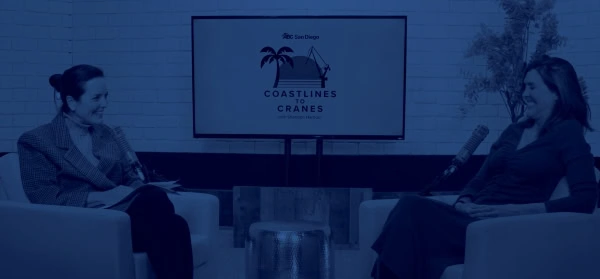
Good morning, San Diego. Welcome back to Coastlines to Cranes, the podcast where we explore the people, projects, and possibilities shaping our industry and our lives. Today, I have the very special privilege of welcoming my husband, Earl the Fighting Pearl. He is a marine fighter pilot and a leader with decades of experience and really truly someone who knows a thing or two about grit, growth, and what it takes to build character. Today, we're diving into the ideas of character building days, those challenging moments that test us, stretch us, and sometimes even break us down, only to build us back stronger.
Whether it's on a job site or in the cockpit or just everyday life, these are the days that are not easy, but where resilience, discipline, and true leadership are forged. It was last week and I was sitting there at our kitchen table and I said, babe, I don't know if I'm going to make it to work today. I just can't. And he looked at me and he said, babe, these are what we call character building days. And so I wanted him to share his perspective on pushing through adversity, finding purpose in the struggle, and really turning your setbacks into strength.
And this is an episode you're not going to want to miss. So grab your coffee, buckle up, and let's talk about those days that define us, the character building days. Welcome, Pearl. Thank you, Shandon. I appreciate the opportunity to share my experiences. As I said before, and my experience with you and ABC, I've come to learn that the construction industry is very, very much, very similar to the Marine Corps. The guys are the same, are very similar. The objectives are very similar. And I think a lot of this will be able to resonate with them.
So I call those character building days. That's that day that when that alarm goes off at three o'clock in the morning and you're tired, maybe you've been working hard for the last couple of days, couple of weeks, or maybe even a couple of months. And it's hard. The alarm goes off. You got to be at work here in the next 45 minutes. And you're just lying there going, man, I'm beat. I am just beat. And you might be tired mentally, physically, maybe even emotionally or spiritually. Most of the time, I'd say probably 99% of the times you can reach down inside, or as we say in the Marine Corps, reach down, pull yourself up by your bootstraps.
And I used to have a technique where we would be given a really, really tough assignment. I'd get my maintenance crew together and I'd inform them of the new orders. And then I'd give them about 15 minutes to bitch and moan to get it out of their systems. And then I'd say, okay, are we done? All right, let's buckle up and let's go do a good job. And 99% of the time that would work, but it works for a number of reasons. One is in the Marine Corps, we have, it's not just a motto, it's a way of life that there's no Marine left behind.
And that's not only true in combat, but it's true in peace and in training times where you build those relationships. I like to call it that culture of camaraderie where the Marines look out for each other. You don't have to like the guy, but you can appreciate his contribution to the team and you can respect him as a fellow teammate or in our case, as a fellow Marine. So the question really is for the businessmen out there, for the team leaders, does your team do that? Do you do that? Do you foster this culture of camaraderie?
Uh, no, nobody left behind. Um, because I, I want to share with you a story for, for me, very difficult to share. Cause I, it's one, uh, for me personally, I, I hit the bottom below zero. Uh, this was about 30 years ago. Desert storm had just kicked off. Uh, our squadron, my squadron was not chosen to go. So we had to, we had to give up parts, people, airplanes to support the squadrons that were going. And I felt like I'd just been assaulted by a motorcycle gang and left to sit there on the flight line by myself.
Um, and then came down, Hey, you got four months to get ready to deploy. And we all thought we were going to deploy as reinforcements to desert storm. So the next four months, very, very challenging, long days, very difficult, challenging, frustrating days. You can imagine, uh, the tensions building up inside the families. We're not sure where we're going to go or how long we're going to go. Anyway, bottom line is we finally get the orders. We're going to Japan and we're like, what? We did all this work to go to a peacetime deployment to Japan.
And yep. And so we had, uh, the 15 minutes of griping. We got everybody together and said, all right, we got to go. We, uh, deploy, we actually transpack, fly the airplanes to Japan. We get to Japan and we find out that all of the support or most of the support had already been forward deployed to support the operation of Mideast. So we don't have anything. And, and it very quickly, we find that the, uh, the money's gone. There's very little money for parts or maintenance support. Uh, and me personally as a maintenance officer, this is very frustrating because my job is to maintain the readiness of the airplanes and maintain the readiness of the maintenance crew.
So fast forward, we're deployed down to Iowa or to, uh, Okinawa for an exercise and we're cycling airplanes down to the Philippines to get them repainted. Uh, about the third or fourth evolution, the CO looks at me and he goes, you're getting pretty grouchy and grumpy here, Pearl. So I'm going to send you down. And it's about a week. And it was kind of like our week of rest and relaxation. All you had to do is fly the airplanes down there and then hang around until they were done and flying back. So to be honest, I was looking forward to it.
I was like, yeah, I could use that. So we fly down to take the airplanes down to the Philippines. The very next day, Mount Pinatubo erupts and it's a massive eruption and it covers the base in about four feet of ash. It looks like a Mel Gibson into the world movie. So for the next four or five weeks, we're busting our butt, no water, uh, um, no electricity. We're eating sea rations from, from the Korean war. And as you can imagine, this just adds to everything. So, uh, four or five weeks of that, we finally get the airplanes up.
We fly back to Iwakuni. And then the night that I get there, I get a call from my wife that my, my mom was in a hospital. She had no, no information, just that my mom was in a hospital. And I was like, okay. So went to sleep about five hours later, she calls me back and says my mom had passed away. Um, so that's about the third or fourth kick in the crotch for this deployment. And I go into work first thing in the morning and I tell the CO that my mom's passed away.
And I said, Hey, don't take me off the schedule. I need to fly. I need something to divert my attention. So he goes, okay, I'll think about it. About two hours later, he calls me back in his office and he has a set of leave papers already made up. And he says, I got you on a, the freedom flight from, from Kadena back to LA. And then, then, uh, that'll get you back in time so you can make the funeral. So I fly back to Los Angeles. Uh, my wife is there. She's already made reservations.
We fly to Florida. I'm in, I get there in time for the, uh, the viewing, the funeral mass and the internment. But you can imagine the tension between the family because I had no idea she was sick and they didn't tell me. So here we go again, medical, mental, mental, uh, exhaustion, physical exhaustion, uh, emotional exhaustion. Uh, I bury my mom fly back to, uh, Los Angeles. The kids are excited to see me. I got to explain to them that I got to leave the next day. You know, they're like, dad, why can't you stay?
So, you know, another kick in the crotch and on a trip back, which normally takes, uh, about 12 hours. It ends up taking about 48 hours for a number of reasons. Airplanes are, uh, or, uh, delayed. Um, bottom line is we ended up landing it back in Iwakuni and it's about three o'clock in the morning. That last leg from Guam to Iwakuni, it's about a six hour flight. And I was done. I mean, I, I, I had run out of energy. I'd run out of give a shit. Um, and I'd convinced myself that that's it.
I'm done. I'm going to quit. I'm done. I don't care. They can throw me in jail. I'm not going to do this anymore. So by the time we landed, it's raining. It's three o'clock in the morning in Iwakuni. They don't park us next to the, uh, operations building. They park us in extended parking, which is about a mile away. And then, so I'm sitting there. Yeah, this is just typical. You know, I got to carry my, my bag and walk. It's about a mile in the rain back to the operations building. So as I'm getting off the airplane, I'm just, I'm absolutely 100% done.
And as I walked down the bottom of the steps, there's my commanding officer waiting for me with an umbrella.
Then he just looks at me and he says, welcome back Pearl. Not much else. He drives me back, drops me off at the barracks in my room. On the way back, I think we said about three sentences and one of it was, uh, you okay? You know, are you good to go? And then he asked me, are you still in a fight? And I said, yes.
So in that simple, uh, uh, act of leadership, uh, my CEO showed me that I was a very important part of the team and that I was worth the investment and that changed my life. And that, so I stayed in Marine Corps for another 15 or 20 years. Um, and I tried to do the same thing for everybody. So I'd have to ask you in your business, if you have somebody that runs into that absolute zero, you know, the below the basement, um, in terms of physical, mental exhaustion, and he's run out of character, he's done, he needs help.
Do you have that culture of camaraderie in your business, in your team that could reach out when a guy's up to his neck and quicksand and offering that hand to get out of the quicksand and then provide the mutual support to say, okay, I'm, you're out now it's up to you. Pull up your, pull up the rest of it by your bootstraps and let's get going. And that's a tough one. So character building is 99% yourself, but that 1% of the time you need that culture of camaraderie to help pull you out of the quicksand when you need that help and guarantee that that builds, that, that builds the loyalty that you want both ways, uh, from the employee up or from the business, uh, leader down.
Um, so character building days. Yep. They, uh, they're, they're, uh, uh, they're tough. Um, and then when you get out of it, you're, you're ready to go.
Sorry, that was a little bit longer than I thought. No, I, I am trying to compose myself. Um, amazing story, Pearl. Thank you for opening up and sharing that with all of our listeners today. Uh, was very much relating to both sides of that story, character building. Uh, clearly I, I couldn't relate exactly with losing your mom and having to go back and be deployed. But when you get down and beat down as leaders, we also look to our team to help build us up as well. And that particular day that I was sitting at the kitchen counter, I was wearing a purple shirt because we have purple Wednesdays.
And when I walked in to the office, everybody was wearing purple shirts and it gave me the oomph to get over that slump or whatever it was I needed. And so for ABC San Diego, we really, truly try to be that culture of camaraderie where, uh, they build me up as much as I, hopefully I'm building them up and holding an umbrella for them. I can only hope that that is the way some of our folks feel. And so members and listeners, if you are, uh, one of those companies that are wondering how you can help build a culture of camaraderie as Pearl, very, very articulately explained in today's episode, give us call, reach out.
I hope you enjoyed today's podcast. Uh, we have it every Wednesday at 6am, whether you're driving to work, having that cup of coffee or, um, listening as you're having your lunch break, as they say in construction. And thanks for, for joining us on today's show, Pearl. It's always wonderful to have you. Glad to be here. We get a giant spike whenever you're on our show. So love to, love to have you. And for all the rest of us out there, stay classy, San Diego. Bye.