Transcript
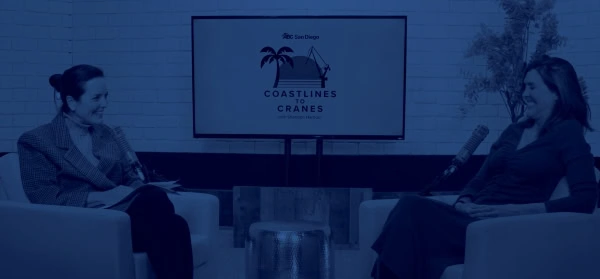
Good morning, San Diego. Welcome back to Coastlines to Cranes. We are the podcast where we dive into the world of construction from the sandy shores to the towering skylines. We are the ones that are bringing you stories, insights, and conversations that connect the people building our communities with the coastlines that inspire us. I'm Shandon Harbour, your host today. From leadership lessons to industry innovations, this is where construction meets culture, one conversation at a time. Thank you for being with us on this Wednesday morning while you're either commuting or sipping your coffee at 6 a.m. Today we have with us our guest, Rowan, the COO from SmartBuild, who is instantly going to mesmerize you with his gorgeous New England accent.
I can stop talking now. And Rowan, you can just do the rest of the podcast because we'll all be listening with bated breaths to your cool accent. Welcome, Rowan. Lovely to have you today. Hey, Shandon. Thanks for having me on here. A little further south, going from New England down to New Zealand. So a little bit smaller, a little bit smaller. Oh, I say New England. Oh my God. It's too early in the morning. It's all good. Yeah. Excited to connect with the San Diego chapter here. I think there's so much that we've bonded over as we've been chatting.
And I'm the chief operating officer for SmartBuild. Our core mission is we're providing technology solutions, project management solutions to small to medium-sized businesses. The technology stack will work up. But if you think of how QuickBooks offers you an alternate to being in full SAP shop, we offer you alternates within the construction market to have a tool that's fit for purpose and doesn't require engineers, et cetera, to install. So that's what SmartBuild is and does. And we're really obsessed at the moment with getting into the local level. So we've been active at an ABC national level for some time.
But I think where the real action is happening is at the local level. So thank you for inviting me in to chat to your members. Absolutely. And Rowan and I spoke and he instantly had my attention when he was talking about getting involved at the local level with our members, specifically about this small and mid-sized contractors that SmartBuild has a solution for. And I was really interested to hear how this powerful technology can impact some of these contractors. And that is the fabric of San Diego and really the fabric of ABC. Most of our members are small to mid-sized contractors, actually 70% of our memberships.
So Rowan, I'd like to hear a couple of things from you. One, in our previous conversation, I'd like you to share with our audience is what do you guys have cooking over there at SmartBuild that really can impact our members? And then I'd also like you to talk a little bit more about how we're already using it. It's nothing to be kind of resisting or afraid of that that is already in our world. So I'll let you take it from here. Yeah. So, you know, within SmartBuild, we've got kind of three core products that will impact your members.
So one is, we'll call it SmartGC and SmartSub. These are project management solutions. Think of it as an alternative. You might be chatting to ACC or you might be chatting to Procore, etc. Like we're an alternative in that space. Wildly better value, focused on the small and medium-sized business. Also really obsessed with adoption. So we want to make this to be the easiest adoption tool out there in the market. And that was built out of the fact that our founder, Zolk, you know, was a GC operator for 30 years. He had it and this was built as an in-house solution.
So this isn't kind of tech for sex sake. This is about a solution that was built for a company being rolled out to everybody. And then the third product that we have out there that's brand new, and this is, you know, real cutting edge stuff, is SmartE. And what that is, is it's an AI tool that listens to you out there in the field and produces your paperwork for you. So, you know, we've all done dictation and notation on our phones and so forth, and that's kind of great, but you have to copy and paste across into different, you know, softwares.
It's not doing the translation. There's 10 steps involved. SmartE is a product that would take you in a structured way through a safety form or toolbox talk or say, you know, delivery, etc. And it will take you through the structured question set to directly input that data into your system. So we're not talking about some separate thing out there. We're talking about feeding it into, you know, we're integrated into Procore. If you're a Procore shop, you can do your safety form and it will show up in Procore. If you're SmartBuild, it will show up in SmartBuild.
And we're really going to focus on expanding that out into other products. And then, you know, the conversation that we were having around AI in the article we just published together is really about thinking about like, as well as kind of our products in SmartBuild, I'm obsessed with helping people understand this AI trend and think about how to get value from it. Because what I'm seeing in the construction community is there's loads of different people on all ends of the spectrum from full, you know, full nerd like me, through to, you know, I still like doing my work on paper and don't like a smartphone.
There's everyone kind of across that full spectrum. And I don't think anyone can afford to be totally left behind by this AI thing, like its impact is going to be too big. You'll have products like Smarty that will just make life easier and kind of pick up off the shelf and use. And then you've got into the, you know, chat GPTs of this world and so forth. There's a real skill curve involved. But what I'm hearing when talking to contractors, there's a lot of folks who kind of may not even realize they're using it. Because whether or not you're using it intentionally, it's being used on you, at least.
Anytime you open up Google Maps, that's AI. Anytime you are browsing a website, the ads that you're getting, that's AI in the background. Every email you're receiving from a company that says your name and, you know, other personalization things, that's AI. And I've spent the last 10 years working in AI, building these sort of strategies for Fortune 500 companies. So in your area, I worked for months with Chipotle, as an example, thinking about how they forecast into restaurants and all that sort of stuff. So it's, it's everywhere. We can't avoid it. But if you're trying to avoid it, you're not going to be building the skills to get value from it.
And so it's kind of happening to you rather than happening for you. I love that. I'll just speak from personal experience too. So I go back when I was finishing college and JavaScript was just coming out and they started talking about potentially doing commerce on the internet or building websites. This idea of, of domain names were just coming out. Okay. I'm dating myself. But I said, no one is going to buy anything on the internet. Like this is just a, like this conversation is not going to happen. And I, I missed that completely. Like clearly that's not even reality anymore.
I mean, that was, that was my perception at the time. Then I remember when my space and Facebook came out and I said, social media, it's fad. It's, it's fad. It's going away. Okay. Call me silly. But on the third time around, I'm not going to miss the vote. So AI is here and I am embracing it. I can share with you that, you know, from, from a perspective of a small business, ABC is a small business. We have 25 administrative employees and we have another 20 part-time instructors. And I said, we need to get a subscription.
We need to start diving into this. We need to figure it out. We need to be researching it. We need to be playing with it so that not only can we be better as business and an offer more to our members, but also understanding it in a way that we can explain it and help our members. And that's why when I had the conversation with you, I was like, you got to get on here because I would love to have everybody hear the wonderful things that you guys are doing. And I was able to interact with smart E the app, uh, at our golf tournament.
So true to your point that you are engaging at the local level and it's wonderful to see you at our events and things like that, but it's really a fantastic product that I think it's not complicated to use. It's not hard. People can grab into it. And I think it's, it's a really neat opportunity. So, um, yeah, I love, I love to see what you guys are doing. And, and I think it's just a mindset that, you know, it's not going away. I'll leave it there. It's not going away. You know, it's only, uh, going to gain steam.
And on this same respect, uh, with Y2K, the panic, it's not going to take over the world either. There's still has to be a people element. So I don't know if you want to speak to that at all, but I really believe that, you know, there's, there was the moment where people were asking the Marines, you know, are you going to need pilots anymore? Because we're all just going to build drones and you don't need pilots. Well, guess what? Uh, they still very much need pilots. Uh, there is, there are drones that amplify and supplement and there's the benefit to that.
But I think in the same way, AI is not here to take our jobs. AI is here to amplify and really make us better at what we do. Totally. And I think like in the conversation we had, I kind of, I'm trying to think like how to frame it in a way that's easy for people. So I'm finding it really helpful to think in kind of layers of use. And, you know, there's the first set of people who are going out there in the world thinking they're not using it and it's either being used on them or they're probably using it in subtle ways.
It's going to be embedded into all the core products you use anyway. So kind of, you can't avoid it. Um, then there's another group, which I think, and this is, it sounds like probably where ABC, um, San Diego is at the moment around like experimenting with chat GPT and asking questions like, okay, how can I use this more effectively? And how do I train my team on it? The sort of like things that come up in conversations when people are there, uh, things like, is my data secure? Um, how do I, like, how do I get away from generic results?
Um, how do I, you know, where does this actually save me time and value? And I think that this layer is kind of a little bit of a dangerous layer because it's really easy to not quite invest just enough time to get to the other side of getting value from it and then give up. And then there's all these other people who kind of get to the other side of it, which are generating value from it. And that kind of the next level, which is really where I think everyone should be working towards at the moment.
And what I'd recommend for you guys is like, okay, if you want to solve that first layer of problems, like one, I'd recommend buying a product like chat GPT enterprise or teams or whatever you're talking like 20 to $30 a month per person. If you don't do that, people are going to be using it outside of your system anyway. So you're going to get this like shadow it thing going on, which isn't great. Um, but also when you do that, all of a sudden your data isn't being used to train their models. And, you know, I say chat GPT, you could replace that with Gemini or Plexity or Claude or whatever, right?
Like pick our big model and buy the kind of basic license for that. Cause it gets you so much further, just kind of coming over that hump and then build skill and how you use it. You know, think about prompting. I mean, there's, there's so much from, you know, just asking it a silly question, you know, like let's talk to someone today. How do we, um, adjust our sourdough recipe to be better at altitude in Denver? Legit use case. Um, but, you know, into more advanced things like, you know, how do we navigate the health and safety and OSHA requirements around heat, um, regulations on a hot day in, um, in California or Florida or, you know, anywhere else.
Um, and, you know, a simple prompt can get you to a toolbox talk that you should give that references the legislation and, you know, really helps navigate. So like just pushing that little bit further into this and, you know, for you or anybody else in your team, like you can't afford all 20 people to be experimenting equally. Um, or it's not efficient to do that. So think about who in your team is kind of, you want to be your leading edge and get them like playing a little bit more and experimenting just a little bit more because they'll, they'll push through use cases around the rest of the business that you can all learn from.
And maybe that's not you like in our business. That's me. That's me. And I've had a guy at Tanvir, you know, he's doing all sorts of nerdy stuff, but our job is to make it simple and drive value for the rest of the business. Not have everybody asking questions like, which tool should I use? No, like don't go multi-brand, just like buy the brand you like, go with it. Like, you know, you don't have every single brand of Milwaukee and DEWALT and whatever on site. Like you, you pick a battery set and you go with it, like do the same with your models.
That's really what I think kind of you and all of your members should do as a minimum standard. And I'm really trying to think about how to crack the code on helping people make that transition because there's 10, 20% improvement in efficiency to be had from doing that. And this is something I want to give away to the construction sector for free. Like this isn't a product. This is not me trying to sell it. It's how do we give that value away for free? Once you get there, then we'll have a chat about, you know, specific tools.
Like, you know, the nice thing about Smarty is you don't need any skill to use it. And you can push this to all of your teams that speak different languages. They don't have to speak a word of English to interact with it. Like it will just get you better information upstream. And that's where it's a customized tool. Like this is not one of these general purpose models that doesn't have anything. It's not some proof of concept thing. Like it's a tool for you to use on the job site that's fit for the job site built by construction experts.
Wonderful, right? So call the auction. I've got members out here who want to reach out to you. Who do they reach out to at SmartBuild or what is the best way for them to connect with you? If you're on LinkedIn, find me, Rowan Steelhall on LinkedIn. I will happily, you know, I'll continue to share information that's relevant to you every single day. Reach out to SmartBuild construction solutions. So you can put it into Google and you'll get to get to our website or smarte.ai. We'll get you to that. And we're happy to chat. If you're interested in like talking about the actual product itself, we can give you a demo.
And otherwise, just want to really want to learn how to help you succeed in your market. Fantastic. And anyone listening can also reach out to ABC San Diego. We can certainly connect you with Rowan and the team there at SmartBuild. Hey, it's been lovely having you on the podcast today. Thank you so much. I'm very inspired to take it to that next level, Rowan. I'm going to go from, you know, just kind of playing with it to really amplifying and seeing where we can ask the right prompts and everything else. So it's been a great chat.
And thank you for our listeners for being here this morning and stay classy, San Diego.