Transcript
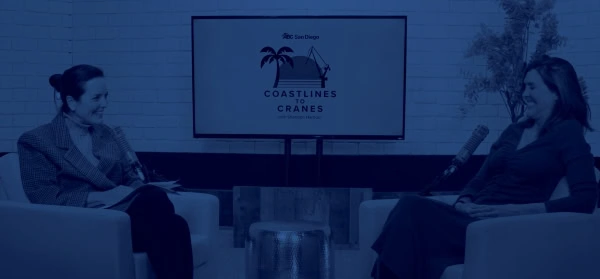
Good morning, San Diego. Welcome back to another episode of Coastlines to Cranes. I'm Shandon Harbour, your host. This is the podcast where we talk about construction industry, the people, the culture, and everything in between. And today, we have, as my guest, Andre Elias and Luis Ortega from Signature Sound. Again, part two of a very interesting conversation. This is where I bring the people from behind the camera, on the camera. And we had such an interesting discussion about the transition of this studio from recording musicians to actually recording podcasters. And how this big effort of where do you, how do you make a difference in the world of all of this content.
And so with us today, we're going to learn about how do you make a difference and what does it look like. Welcome, Andre. Welcome back, Luis. So nice to see you again. It's great. You know, when we were talking about it on our first segment, you pulled me aside and you said, you know, Shandon, I want you to come back and see this huge console and all these different things that nowadays are now done in the home and everything's gotten very small. And how do you differentiate yourself when you're just, to quote you from our last episode, a drop in the ocean?
And you turned to me and said, no, you need to talk to Andre because he understands this. So we're going to just pivot quickly to Andre and we'll come back to Luis. But tell us about yourself and your background. Yeah. My name is Andre Elias and I'm a recording engineer and producer. I've been recording and working here at Signature Sound for like 14 years now. I had no idea. Yeah. Oh my gosh. Wow. And yeah, I'm based here in San Diego. I work with a lot of local artists, a lot of bigger talent that comes by San Diego and I'm able to work with through the studio.
Great. And yeah, so I've seen a lot of local artists try to build their community and brand. And I think that's what we're here to kind of. Exactly. So tell it because, you know, we were saying like, OK, you're just there's so much music produced and songs that are produced. It's hard to differentiate or how to explain how someone would start or even figure this out. So I mean, we chatted a little bit about now the merch is even more of the sales point than the actual song. Yeah. And how Miguel touched a little bit on it on our first episode.
But you have to build this sort of following, right? Yeah. Or culture or universe. Yes. Well, from what I've experienced and what I've seen local artists have success with, it's yes, you have to put your own shows together. You have to make your merch and, yeah, the song is not the focal point of why you make the song and like what people go listen to. That's almost like the ad to go buy the merch and to go buy the record and the vinyl, which is very popular now again. Really? Vinyl's coming back? Yeah. Luis, vinyl's coming back?
Yeah. Yeah. People are pressing vinyl and that's what's selling. And people want to own something physical more than just something from Spotify or from iTunes because no one's buying music on iTunes. They're just streaming it. And people really do like to support artists they love. And if they can buy a shirt or a vinyl or something, that is a way for artists to now build their own community, not need a record label to press the record for them. And they could raise money, make a single or a record and sell it to their community. You know, you have to build a store.
You have to have ways to sell directly to your audience and you have to know your audience.
That's small things that I've seen local artists do that help them move forward that a couple of years ago wasn't really clear of what you could do. Because now you could have your store on Instagram or there's websites, there's one called Bandcamp where you can sell directly to your audience. Interesting. I'm so fascinated by this. And I think it's really just one of the things that we were just talking about, too, is, hey, the content that you're developing. Okay, so, you know, three listeners that I have, my mom, my dad, and my husband, and myself, maybe, and that was a couple of views that were me.
But you start building the base of the members or whoever it is and you get your following around that. So, similarly, like a musician would kind of create their own base and then you're feeding it back to the base. A little bit more of like Miguel was saying, you create your own and then you just continue to feed back into that. I just think that's so interesting. A lot of times, too, that they're talking about, even with the news or in construction, as it relates over to this, is you have to create your own content and send it out.
Like, what are you doing at ABC that's interesting? Like, okay, well, we're going to talk about it. We're going to talk about our podcast.
So, yeah, I think that has a lot of relevancy, not just in the musician world, but so much on what everybody's doing. You know, like podcasting or whether it's building content or businesses or, you know, if they're trying to create their base and who are they, you know, who are their clients. Yeah, be able to have the people that are hopefully trying to get in contact with you get to know you online so that they seem, so that you seem real to them. Right. Not just like a far off, in our case, like an artist that's unreachable or something.
Right, right. You know, it's so funny because I was a slow adopter to social media. I have to say that I was, you know, like, oh, it's a fad. And then I, you know, did LinkedIn or LinkedIn in or whatever we say, you know, and I sat on LinkedIn in forever and I didn't really engage. And then you sort of get into that world and it's true. You get to know people online that I would never have connected with before. Right. So it's and the video and all that adds to that. Yeah. And it's easier than ever to reach your audience.
Right. Exactly. What do you think about this, Luis? I mean, that's all part of your signature sound studio and your base, right? It is a different perspective because from where I stand, I can't make money with music. I mean, we still get some bands that are able to pay a little bit more every now and then. But I just don't know how a musician can make money. Yeah. What I see is live shows is the main place where I see musicians making money, playing live at bars or restaurants and doing covers, which is not a place for them to promote their original music.
Right. But they're able to play. They can have a gig playing at a nice restaurant or a monthly event somewhere or even musicians that play at bigger churches. Right. Once a week.
Yeah. Yeah. It's not necessarily from the selling of a record anymore because you spend, let's say, $1,000 to make one song and you sell it on iTunes for $1.29. So it doesn't make sense that way. That's just amazing to me. And also… I mean, it's only $1.29 and then you said that they may only get 10 cents of that, right? If that. If that. If that, yeah. So that's why also selling directly to your consumer is way more important because a super fan of yours, you can promote on Instagram or TikTok that you just made a song that you're never going to release on a streaming platform on Spotify.
And if they really love you, they can give you, you can put like a pay your own, you know, name your price and they could give you $20 for one song and they could stream that same song on Spotify over a thousand times and it would maybe amount to half a penny that they would have paid you. That's incredible. So you could sell one song to a super fan for $10, $20 and that's more than they would have ever given you through Spotify in their lifetime, maybe. Wow. Like years of, they're not going to play your song a thousand times.
Right. So you could, it's way different now. You don't, you can't rely on streaming. You have to be able to connect with your audience and find ways to sell directly to them. Right. Interesting. You were in the room when we, when Louise showed me where I thought it was going to be, oh, we recorded this artist in our studio and he crushed me with it was AI. What are your thoughts around AI in music these days? I mean, is it something that is going to take over? Has it already? I don't know. I mean. I think it creates a different lane.
Currently, it's a confusing space. It is. For me, I'm always going to be on the side of the musicians. Me too. Amen. I love a good, authentic musician. Yeah. And some good original music. And I'm the gal I told you at the back of the, after the show, buying the CD that I don't even have a CD for, but, you know. Yeah. Anything to support local artists and musicians. Yeah. And a lot of the streaming platforms are now removing AI music. They're not allowing AI music. Okay. It's still not a fully regulated thing. It's still getting by.
And there's actually, I've seen a lot of situations where artists are getting their songs stolen and really, like, let's say, recently it was popular to kind of promote your song before you release it to kind of make your audience feel like they're part of the growth of the song. Like, oh, should I release it? Should I do this to it? Like, what should I do for the video? And you get them engaged and they feel part of your team. But now, if you do that, someone can find the video and put it into an AI music platform and make your song before you've even put it out.
And they put it out. And I've seen that's been happening a lot lately, too. To where they get, like, 30 seconds of a song that they see on someone that's getting ready to release. Pre-promoting it, right. And then they'll get that piece and maybe they just finish the lyrics. So they rip it, like, they just take it. And have, from those 30 seconds, have an AI machine finish the song. And then they release it and artists have been catching those things. And it's hard to, what's the legality of that? Right. That's still not defined. It's still the Wild West.
It's still the Wild West. You exactly used my terms, Andre. The Wild Wild West is out there with the AI. Oh, my goodness. Yeah. But now, for some people, music, it's becoming, like, an experience. Like, going to a restaurant or to, you know, sing, like, to a ride. Yeah, or, like, skydiving. It's something they've always wanted to do to where that has given us more business, in a way, where someone that's never done music before makes a song on an AI platform. And then they want to sing it. And they go to a studio. They book us.
And they, you know, book a session. And they try singing. And they feel like an artist. And it's something they've always wanted to do. And maybe they get into it. And they keep doing it. And then they find, hopefully, they find ways to get more into the actual creation of music. And, in a way, it works backwards, hopefully, that it gets them into actually making real music, you know. This is amazing. So, potentially, like, if I, so we've got chapter presidents like myself at ABC that are all coming to San Diego in July. And some of them love karaoke.
If we get them in here, could we be producing a song? We could almost do Remember We Are the World back in the days of the 80s. Could you, do you think we could do that? Absolutely. Like, we could create our own song, right? Mm-hmm. You could prepare. I'm booking us. We are all going to come down. Because somewhere deep in our hearts, we all think we're secretly, like, some kind of rock star or movie star or something, right? And now you can be. Because you can create. And now we can be. You can just prompt your own song.
Because we know Signature Sound. And they used to do similar things like that. I remember my brothers, when they were younger, went to Universal Studios. And they had, like, a whole set. And you could be Guns N' Roses playing a sweet child of mine in the music video. And they have the video of them there. And it's like an experience. Yeah, something that they always wanted to do. And now they feel like they're Guns N' Roses or something. You are. I think I did that with my mom and my sister. It used to be where you could go in a place and do that, right?
Yeah, yeah. And we did Country Roads with John Denver. Okay. You know? Country Roads. Wow. I mean, that was amazing. And you could stand in front of the kid in the video. Yeah. And they put it to music or whatever. But that's essentially what you're doing now. But AI is sort of helping create a real, a more realistic thing, I guess. I guess a more tangible experience for them. Okay. If they, before maybe if it was someone, oh, they wanted to have the studio experience and they grew up playing guitar, but now they're a real estate agent or something.
It's harder for them to come up with a demo and leave with something decent. Right. And you guys do that here. Yes. Essentially. Like, if somebody wanted to do that, I could tell them, look you guys up. Well, we'll tell them now on the podcast. Well, yeah. We're a recording studio. Yeah. We put mics up and cameras.
That's incredible. Oh, my goodness. Well, it's been such a journey. Anything else that you want to add, Luis? Like, things that have not been, you know, asked or said in our conversations? It's so fascinating. I'm just amazed at what this journey has been for. The best skill that you can have these days is knowing how to change constantly and learn constantly and quickly. Yeah, be adaptable. That is such a great, great way to end the episode. I mean, isn't that the truth? Be adaptable, like Andre said, and be, you know, willing to change and continue to look forward and see the ways that we can adapt and move and be flexible and stay relevant.
So, well, thank you both for being on our podcast today. I really appreciate all the hard work that you guys do to make our podcast successful at Coastlines to Cranes. You are truly the people behind the camera, and I just wanted to make sure our audience was able to meet you and see you and see the wonderful work that you're doing in San Diego. So, thank you so much. It's been a great conversation. All right, that wraps up another episode of Coastlines to Cranes. Thanks for listening today. Thanks for watching today, the video part, and we look forward to hearing more from you in our comments.
You know how it ends. Stay classy, San Diego.