Transcript
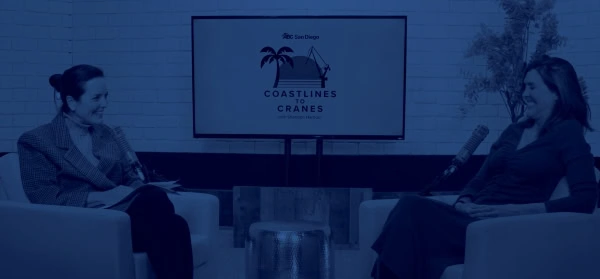
Good morning, San Diego. Welcome back to another episode of Coastlines to Cranes. I'm Shandon Harbour, your host, and this is where we bring you the coast to the cranes, the people, the culture, and construction and everything in between. We are your original construction podcast where we enjoy telling you the story about the people and the fabric of San Diego. Today we have with us one of my dear friends from Signature Sound Studio, and I thought it would be amazing to take the people from behind the camera and put them on the camera because I know as listeners you want to see what's going on and how did we get to be a video podcast.
Well, I've got with me today, Luis Arteaga and Miguel Rosales. They're going to tell us their story and they're going to share the journey of Signature Sound Studio. Welcome, Luis and Miguel. We got both of you today. Louise, when I first was looking for moving our podcast to video, I looked around, you know, people used to say, oh, you Googled it. Well, I didn't Google it anymore. I asked AI. AI came back and said, you need to call Signature Sound Studio. And I said, oh my gosh, okay. So we got in touch and I came down here and learned your story that you've been in business for quite some time.
So let's just start off by telling our listeners about who you are, about Signature Sound, and tell us, you know, yeah, you've been around for 35 years. Yes. We started recording music mostly, not video at all, 35 years ago. Amazing. Amazing. And at that time, having a recording studio, you had to have a $300,000 console and $50,000 tape recorder. Right. So most people didn't have access to one. But then the revolution started. Yes. And they started making affordable equipment, recording equipment. And then instead of paying $50,000 for a recorder, you would pay $1,000. And so people started just buying them, like hotcakes that changed things drastically.
And it was going to be hard to survive. And that's when I just decided just to buy our own cameras, our own gear, switchers, lights.
And we started just slowly, but surely, making more and more video production. And the good thing is that we have a good sounding room. Right. Good sound, space, and high ceilings. So it's perfect for video. Right. Perfect for podcasting. Uh-huh. So now, you know, I see you quite all the time. And we're talking, and everybody has a podcast. And there's so much video content out there. And like you were sharing with me, yes, everyone has a podcast. You guys are able to market to that now. But not only that, the video that corporations use, right?
Yes. So tell us a little bit about, you know, the shift from video and podcasting and now what your days are made up of. So it's not only podcasting. Right. Some people create content just for internal communication or for education of their employees. And so it's almost like every time there is a different type of client that comes here. And that's exciting. It's a good thing. We hear great stories from people like from your podcasts. Oh, wow. Yeah. And I love your stories. That's why we had you on the podcast. So I was like, we got to get you on the podcast because your story is amazing.
I mean, I think it's incredible. 35 years is a huge accomplishment in any business environment. But especially watching where you've seen the sun setting of music and how music was made and created. And I can very much relate. We'll talk about Miguel in a second. But you and I have lived through this journey of large systems and consults and lots and lots of money and investment in this. And the obsolescence. And the obsolescence. And now it's all, you know, in the size of our phone, which is what he uses. Right. So, yes, we'll shift over to Miguel really quickly and then come back to to Luis.
But Miguel, you know, Luis and I were chatting. You're just a tad older than Luis's grandson. And definitely, you know, the younger generation. Tell our audience that you're still in high school. Right. Yeah. But you actually started your own business. Tell us about yourself. You started your own business a few years ago. And yeah. So I first started photography back in sixth grade. That was when I was really interested in it. And I felt like I couldn't really tell much of a story just personally when it came to photos. I know a lot of people can do it.
But personally, I felt like video was something that really brought that out in me. So I started doing that and I really got into entrepreneurship. So I started several little businesses doing like cards, doing clothing. And I put a lot of time into that. But then I found that marketing was the thing that really held everything back because I did the designs. I had clothing manufactured in China. I put all of my weekends working money into that. But no one ever knew about it. So in the summer going into ninth grade, I was 15, 14 and a half, 15.
And I spent just a couple months learning about marketing and really trying to dial in into it. And at first, it wasn't something that I truly loved just because it was so technical. There was so much that went into it. And it was like different softwares to learn. But I really knew that if I wanted to build something big, it was one thing that I had to just put full effort into. And this was just when AI was really getting started. So it was a lot of manual work, which I'm really grateful that I had to do now because I know like the back end stuff.
And it's not just telling Claude to do everything.
But yeah, I was doing that. And I was doing around two years of free work, just working for different businesses, just trying to get profitable because that was like the biggest struggle at the time and just trying to find what works. So then I got the opportunity to work here, doing video, doing the marketing here. And now I'm also still doing a lot of my own videos, a lot of my own marketing. And then now total, I'm doing seven stores as marketing. Wow. Congratulations. Thank you. You know, we're going to talk to Andre in our next segment.
But so much of what all of this is pulled together by the fact that everybody has to build their own culture, their own merch, their own, you know, build their own universe, I guess, around themselves. Right. And so Signature Sound has its own culture and following. And I love the people that I think that's really what attracted me to working with you is because the people, you guys have such great hearts and you've got this uniqueness about you and you've already got the studio because it was already something that was created with your prior experience with albums.
But now how it's transformed into video and podcasting and everything. So, yeah. Tell us a little bit about, because it's interesting, Luis, when Miguel can just talk fluently about AI and, you know, Claude and this and that. His generation is very much already used to it, right? Like this technology and marketing and social media and AI is like, oh, you know, Claude could do this and that. Talk to us a little bit about how music and the way the next generation, you know, the way things are happening now in our next transition is this thing with AI and music.
Oh, it's unbelievable. You know, some people like Andre, who are engineers and have been doing it for a long time, he can tell when something is AI. Some people who have great ears, you know, great hearing. But I've been here 30 years and I don't, to me, it just sounds amazing and it's just getting better. And the songs are great. I mean, that's the song that I just showed you. Right. You thought that we had recorded here? Absolutely. I don't think we ever recorded something that good here. Really. Right. I mean, I was fully prepared for you to tell me at the end of the song, because we had just recorded for our listeners.
Luis took me and showed a song and I fully believed that that was something that was recorded here and that you were going to say, oh, you know, he was just here. We just recorded this. I mean, it was phenomenal. And I wanted to show you that because the topic of your show here today was how the recording studio turned into a video studio. That's what I wanted to show you because we would not be here, this studio with the overhead that it has, we would not be in business if it wasn't for video because we diversified.
Right. You know, musicians don't have much money. Most of them. Right. Maybe, maybe 10% of them or 5%, the big, big artists. But the people who buy gear, are talented, make some songs, they upload songs in Spotify. It's like throwing a drop of water in the ocean. Right. I love that saying, the drop of water in the ocean. Yeah. And it's just impossible to see it. Right. Like we were saying, I mean, you can try to create a splash, but how much that splash is going to cost you. Right. In promotion. And so I see it more as a communication tool with your own base, with your own audience.
That's an excellent point, you know, communication with your own base or communication tool with your, you know, universe, I guess, or your civilization or your base. Because, you know, I certainly don't anticipate that my podcast is going to, you know, we were talking, you know, it's a small drop in the ocean, but it definitely. But it is a service, right? It is. It's a service for, for the people who benefit from it. Exactly. Yeah. And it's content for the construction industry and our, you know, it's going to be interesting because I bet there's a lot of people that are going to call you and say, hey, we need content for our business or our podcast.
There's construction companies that are doing their own podcasts and they might connect with you and say, we want to come and now add video to it. That'd be great. Yes, absolutely. So how, you know, then Miguel, because I know your angle is definitely marketing and you are showing me one of the first times I did the podcast, you're like, you know, you could do this and you could do that. How do you differentiate a podcast in this world of like the drop in the ocean?
So really recently, like in the last month, my perspective completely changed on content. Yeah. And I've been really grappling with it because I've really struggled to make a attractive content so I can have, you know, the best studio here. You know, I have great cameras. That's something that you should always focus on. And throughout, I've always been working, you know, to get better cameras, better gear. And I used to think that that was the differentiating point of what makes something good to great. But now I've found that trying to chase just, you know, the followers isn't something that's going to get you really anywhere.
You should kind of be seeing it as building a community. So recently or this month, I've gone beyond what I thought was possible. So right now in my Instagram, I have like 1.7 million views just for the month. But I've never gone over like 5,000 views. And it was one big change where it was making content that people want to feel one thing, like focus on comfort and something like a laugh. And the reason I say comfort is because people find like some of the same things like funny or silly. And just trying to recreate that is what gets people engaged.
And that community, once you find it, you have to really dig as deep as the hole can go. And then that way is people are just going to keep flooding in. So I found that my sister does like her own TikToks and she gets millions of views, likes. You said millions? And it's surprising. And for you too, millions? And it's surprising because like she does like random videos. Like she'll be like, hey, Miguel, I'm going to make this video. And I'm like, yeah, nice. And it'll get, you know, hundreds of thousands of likes and shares.
And I was struggling, you know, even just to get, like I mentioned, 5,000. So I found that it's all about making something that people find either funny or find comfort in. And that's when they're going to really engage with you. And I keep saying that word comfort and it's kind of hard to explain. Right. But I think if the reason that famous people go on movies or famous people go in advertisements is that people find, they recognize them. They find comfort in that person. It's not just someone completely new, a brand new advertisement. And that's why they're engaged in it.
So I think that's one of like the secrets of getting engagement, finding something that people find comfort in, whether it's a laugh, whether it's, you know, a certain topic that they relate in. And then that's how you pull them in. And once you find who that person is, just really trying to tailor to that specific niche. And that's how you start building your community. I'm so fascinated right now. So that means like if you like our podcast, do those millions of viewers find us?
If you post on this podcast, are we going to get millions of views? All right.
Oh, no, that's amazing. But it has to be the right audience, right? Sure, sure. No, I mean, but it might be interesting because Miguel's age range is for folks that are looking at what are they doing, you know, you're a senior in high school right now. Oh, you're still junior.
Right? It's just about all that I'm saying.
But same age-ish where people are trying to figure out what they want to do with their lives. And are they going to go to college? Are they not? What do they do? And so some of the ages that we're talking to in our outreach programs are in your age range. So we wouldn't mind their views either. Yeah. Right? Yeah. Exactly. So that's really fascinating. You know, we'll talk more about that in our next segment with Andre. But before we close out, is there anything else that let me make sure that our listeners understand who you are and where to find you.
Tell us where is there our marketing guy. Where should we look? Where should we tell our listeners to go for Signature Sound? So if you're looking to find more info on Signature Sound, whether you want a book or just learn more about the studio, you can go to SignatureSound.com or you can also find the Instagram Signature Sound Studios. You can search it up. It'll pop up pretty top of the list. And there you can see some videos where you'll see some of the sets that are possible here, the podcast room. I think one of these two.
And if you want to find me, my Instagram is the best. It's Métis underscore Miguel. So M-E-I-T-I-I underscore M-I-G-U-E-L. There you go. Yeah. Awesome.
And thank you for that. And Luis, we always have to like end with a little bit of a kind of a different thing. So you came from, tell me again, you're the hometown, your original town. Oh, I came from Mexico City. Mexico City. I was born and raised in Mexico City and I moved to Oregon right after college. Wow. And I worked there five years as an industrial engineer and I hated every moment of it. And my heart was in music even back then. And I started like a small studio in my garage in Oregon.
Then we moved here and I had my steel in my other garage here in San Diego. I had my equipment. At that time, the person that built this place had over committed in investments, in different investments.
And it was like halfway built. He couldn't continue with the construction. And he came to me. He knew me. You want it? Just sign the lease and you can move your equipment in there. Can you imagine the change? Right. And we thought that with maybe 50 grand, we can finish it. So I contacted some of my school friends and we raised some money. 50 grand was just the start. Yeah. I mean, sleepless nights.
But we were able to do it. We got through it. Amazing. And I was going to say, muchas gracias. De nada. Sí, para todo su apoyo. As I say it right. Thank you so much for your support. All right. Thank you. And that is a wrap for this episode of Coastlines to Cranes. If you liked us, give us a like, send your comments, and you know how I always end. Stay classy, San Diego.