Transcript
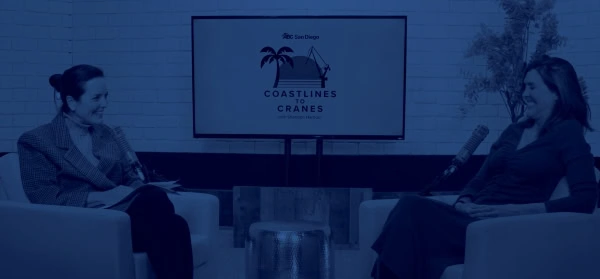
Good morning, San Diego. Welcome back to another episode of Coastlines to Cranes. I'm Shandon Harbour, your host, and this is the Construction Podcast where we bring you everything about the construction industry, the culture, the people, the policies, the politics, and everything in between. And today, as our guest, I have a dear friend of mine, Amy Fawcett. She can She comes to us with a long history of experience working with our former mayor, Kevin Faulkner. She also worked for the Chamber. She has a vast experience in policy, and now she is leading one of the industry's most prominent housing associations, the Building Industry Association.
And she is a fellow San Diegan. Please welcome my very good friend, Amy Fawcett. Welcome. Thanks, Shandon. It's great to be here. I forgot to say you're a professor of San Diego State. Oh, yes. I do that. I have two jobs. Yes. Yes. Busy, busy gal. Yes. Professor, go Aztecs. They're graduating this weekend. Oh, awesome. Yay. Yep. Yeah. Welcome. So, okay. Little known fact that our listeners don't know about us is that we share suites. We share, we're suite mates. Suite mates. Office suite mates. Yes, we are. Your office is down the hall. Every once in a while, we have to close each other's doors because we're both too loud.
Yes, that's the case. We're having way too much fun down there. Close the door. We are passionate about what we do. We are very passionate. Very, very passionate. So, um, it's really fun to have you on the podcast. Thank you for having me. You know, I appreciate you're doing the podcast tour. Thank you for having, for coming here. Um, but it's interesting because I know you as Amy. Yes. And yet I want our listeners to understand how much more you are now working with the BIA and all the stuff that goes with that. And so tell our listeners about what are some of the myths related to like builders and developers where there's an image that comes to mind when you're working for builders and developers and myth bust that for us.
Yeah. What does it look like now? So I think, I think there's a misperception as to what the housing development industry actually is and looks like. Um, I think we focus a lot on wealthy developers that are making, you know, millions and millions and millions and millions off of building a house and not to say that builders and developers aren't obviously very important. Uh, they're actually key to it, but the industry is bigger than a developer and builder. It comes with, um, architects, engineers, planning, um, law, land use lawyers, um, uh, landscape architects, trades from carpenters to electricians, and not, not only that, but also manufacturing, uh, furnishing and fixtures that go into building a house.
And so I think that the industry has been pigeonholed into one particular group that build houses and obviously they are at the tip of the spear and they're important, but the industry is so much far deeper than that. And I think that that gets missed. Um, you know, it's our cousins, our uncles, our aunts, our children, um, our parents, our siblings that are all working in the industry. And I don't think people quite understand that it's, it's a broader depth, uh, broad and deep of who is actually creates a home and builds a home. It's so true because when I start talking to people, they're like, Oh, do you build homes?
And I was like, no, that's actually BIA. That's Amy. We're commercial side, but it, uh, you know, everybody knows somebody that's building in the residential space or, you know, the, the home building space. And, and so, like you said, it's cousins, aunts, you know, all of the community at large, but so oftentimes, especially when you hear when policy and those discussions come up, everyone thinks, Oh, it's just those guys, the developers, the bankers, the bank rollers, if you will. And there's something to be said about that. Very important happens. It's, you know, they're the ones taking the risk.
And that's a lot of times what we're trying to educate a lot of our industry on is that, you know, the business owners are not the evil business owners. They also are the job creators. So people don't move into jobs on their own. The job creators, the people that are taking risks are the ones that are making industry happen in San Diego. And so we can't lose sight of that when we're creating these interesting policies. Yeah, exactly. And, and one of the things I say is government doesn't build housing. It's, I'm going to steal that line.
Builders and developers build housing. I'm going to steal that. Can I steal it? I will say, my friend Amy said, government doesn't build housing, but similarly, government doesn't build commercial stuff or airport terminals. They don't build. They contract out with those type of things when they do do it, but government doesn't build. And I'll go out on a limb and say an organized labor doesn't create jobs, right? It's the businesses that create jobs. And I think that, um, it's not a knock on organized labor. It's just the facts that kind of, I think in the debate of policy and in the debate of building, uh, gets lost.
Absolutely. You know, we had our good friend, Chris Kate on the, on a former episode and, you know, he was talking about being unapologetically pro business. And I think that that's part of my fun and having you on the podcast. Yes. It's about a podcast about construction industry, but it's all also about what I like to call getting the band back together. And, and this, this pro business effort in San Diego to say, okay, and we understand the importance of the worker. And I understand that we want to make sure everybody's treated fairly. And that is absolutely true of your, uh, members and our, and our members that we treat people fairly.
We give them the proper wages. We give them all the medical, but you know, all the things that is appropriate. And yet, um, I think that business owners and sometimes the developers get demonized that they're the ones that are, you know, the enemy. And I think, well, hold on a minute. We need to be pro business to move things forward. Like you said, organized labor doesn't create jobs. So, uh, you know, talk to us about how you decided to come back to this role at the BIA and, and, and what attracted you to that? Cause yes.
Uh, so, uh, after working as chief of staff to the mayor, um, there was a heavy burnout, right? Not only was, is the job just in general, high intensity and high anxiety and high stress, but we came off of COVID. So, um, we left office in December of 2020. So I decided, you know what, I think I'm just going to take some time, uh, do some government affairs work. Um, I spent time, uh, one of my clients was a San Diego working waterfront, which is another business organization for your listeners. That is all the tenants that, and businesses that operate in the tidelands of San Diego.
Um, so I was doing that and then I thought, you know what, I'm ready to start. I think I'm ready to get back into it. Um, dive right in, uh, full time, uh, be a little bit more, uh, active and present. Uh, and so this job came along and I applied for it. And here I am clear, clearly the best for this job. I was like, thank you. Thank you. We want to make the announcement. And then I found out, I was like, yay. So as Chris Kate says, unapologetically pro business, I am unapologetically pro housing.
Wow. And whatever it takes to build a house. Cause people need to be housed. Right. And, um, we just need to do it. Yes. Uh, I just wanted to give a nod to the San Diego working waterfront. Love those guys. So all of our friends there in that organization, just a shout out to you guys. But, um, you know, going back to unapologetically pro housing, a word for me that I am still trying to wrap my head around affordability. It's a buzzword. It's in every news article. Every time I look at Cal matters, affordability, affordability, affordability.
What, what is that? What does that mean? Is that just a buzzword or what? I mean, help us understand how this all comes into play. I think you said we only have 15 minutes. I don't think we can do it. Um, I think affordability is, is, is, can the common person who has a job or a family that has two jobs or one job, can they actually afford to pay their bills? Can they pay rent? Can they pay their mortgage? Can they pay utilities, food, gas, just the basics. Um, I think that's what we talk about in affordability.
And I also think that what happens is, is business gets, um, it's always pointed at its business's fault. I like to use the analogy, an example of, you know, what's the per cost of a gallon of gas, right? Does anybody really know? Like, I think the average person may make the assumption that all that money goes to a gas company, right? Um, well, I think if you look at the level of evil corporate gas guys, exactly. Eve, the evil ones, but it's also government tax on layers and layers and layers of fees and taxes. And although government thinks we're going to make the, you know, the business person pay, they have to absorb costs too, and they have to keep the lights on.
So there is going to be a passage pass on of these fees. And one of the things that we're going to do at the BIA and in to take it from a position that our elected officials and our policymakers don't understand because it's not their job to really, they have, they go from, you know, housing to, um, permitting to parks, to libraries, to public safety, they're all over the pace. So they're the Jack of all trades. And I think it's incumbent upon us to really spend time and be patient and walk them through what it looks like to a business's budget.
If you adopt this policy, let's do a, let's do a, a, a, a mock performa. Um, okay. You want to add this developer impact fee. Okay. Well, let's show you where that hits the bottom line, what line item it hits and how it will get, what part of that will get passed on to the consumer. And I think we should be doing that with all the industries, different industries that we help educate them. So when they are, whether they absorb it, cause they're not in it every day, so they shouldn't be expected to, but they should have, when they go and adopt a policy or adopt a fee, they're thinking in the back of their mind, oh, wow, how is that going to literally impact that consumer or that business?
And it's incumbent upon us to do that education. I couldn't agree with you more. I mean, I was sitting there looking at a restaurant bill the other day and 23% service charge tax. And I was like, is it, I asked the server, is any of this going to you? And he said, no, it's all going to the house. And that's all those added fees and costs that, that any business in any industry, you talk about housing. Um, but clearly it hits the restaurant business. It hits our friends at the working waterfront. It hits all of our construction.
It's the cost of doing business. Right. I think that people also have to, the public also, in addition to the, the public policymakers need to understand what it takes to run a business. What are all the fees and taxes and overhead and, and rent and, uh, cost of doing business. Um, those are all real legitimate things. And, um, it would be helpful if people took a little bit of time to get educated on those and what it is that government is causing those prices to increase and making them unaffordable. Right. Exactly. Uh, well, great. Thank you for that.
Look, you did it. And we were almost about out of time. Yeah. Um, so it's so funny that we have to set up a podcast to actually have a conversation and we're sitting, we're like across the hall from each other. Uh, but yeah, no, I, I guess the last little thing is, um, association management and you know, your role as president and CEO of the BIA and you were with the chamber before too, right? So, um, working with members, you had some time to do your government affairs. What's it like coming back to association land?
Um, it's, you know, it's interesting because, um, I know this cause I'm in the same world. So I'm actually just asking you, you know, it's, um, it's different. Um, I'm having, I'm having muscle memory, right. Uh, from the chamber, but also at the working waterfront and spent so many years in government. They are two very different business organizational structures. And so association work is like running a business. Your members are your customers and your clients, and, uh, you still have overhead and all of that to do. Uh, but it's really fun. Uh, it's really fun to be back in the association world, uh, supporting business, um, housing.
And so, um, it's, it's good to be back. Yeah. It's great to have the best. Things changed. Yeah. And, uh, Mark Kersey is going to be on our next episode is getting back together. It's very, very fun. And it's great to see the impact that is having on city council too. I'm, I'm reading the paper and seeing that there is a pro business movement that says, look, enough is enough folks. We can't just continue to tax, you know, and, and to layer fees and to push policy that burdens businesses because that's, that's what makes, that's a fabric of America.
Yeah. Right. Yeah. It is. Absolutely. There's a whole different side story and, uh, uh, to the, on the other side of business and it's not being told. And now that we're all back together, uh, the band is back together. I think that's one of our priorities is to educate the public as to what it takes, uh, to run a business and what government policy fees and taxes actually do to that business. Excellent. You know, Amy, I'll be completely honest. Um, when I first got to know you, I would look you up online. I was like, wow, she's so cool.
She was like at the chamber and your picture and then eventually chief of staff. And, um, I was just so honored to meet you. And then, um, you know, we also have a, uh, uh, a connection from the Point Loma land. Absolutely. Yeah. You know, uh, uh, your husband knows our family very well. Um, high school, middle school and high school. So San Diego is the smallest big town there is in the whole world. Yeah. I absolutely believe that. It's like, everybody knows everybody. Um, but yeah, I'm, I'm so honored to have you on our podcast.
Thank you for having me making the time. And if our listeners want to reach out and connect with you, is there a good way to go on your website or what's that? How do they go to the website? That's absolutely. You can find any one of us, um, the team on there. Um, that is one thing we'll be updating. So keep that in mind when you do go to the website. Uh, but yes, that's the best way to reach us is through, um, the website. Great. Yeah. We're updating our website too. Oh, awesome. We've got to, we've got to share stories, swap stories, who you're using, who we're using.
That's right. Not just on, we don't just need to be on the podcast. We need to be in the hallway. All right. That wraps it up for our episode of coastlines to cranes. It was great talking to Amy. If you have any comments, put them in the, in the comments below, give us a like or hit subscribe. And you know how always in this show stay classy, San Diego.