Transcript
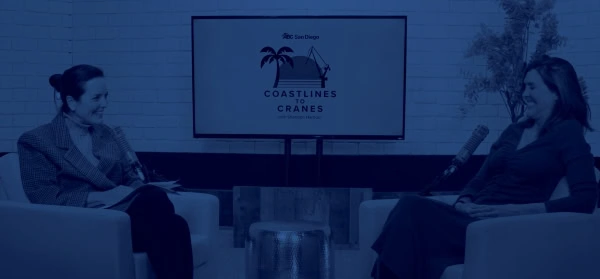
Good morning, San Diego. Welcome back to another episode of Coastlines to Cranes. This is your original construction podcast. Talks about the people, the culture, the industry from the coast to the cranes and everything in between. Today's podcast we have as my guest, a dear friend, former council member, Chris Kate. He was your council member from 2014. to 2022. He was leading the way and on his last year of tenure was the last Republican council member on the council. He is a very solutions-oriented, policy-focused gentleman. He is not afraid to roll up his sleeves and get work done.
He's known to get things done by talking across the aisle. He's also very policy-focused on public safety, infrastructure, and other things that matter to you. But today, he is your president and CEO of the San Diego Greater Regional Chamber of Commerce. Welcome, Chris Kate. Thank you, Shandon. I appreciate it. Yes, so glad to have you here. Glad to be here. Oh my gosh, I feel like I've known you so long because I remember when you had just gotten married, you became our legislator of the year in 2017. And since then, Madison Rose was born in 2018.
And now you have two additional children. So you're a family of five. Love it. Yes. I've watched you grow and I've also watched you grow and succeed as a leader in our- You've seen the gray hairs come in there. Yes. Comes with the territory as president and CEO of the chamber. Yes, for sure. But you've done amazing things, Chris. Thank you. And we're just really, really delighted to have you here on the podcast. One of the things that struck me and why I wanted you to come talk to our listeners was when you became the president of the chamber, you came and spoke to our members and our PAC committee and you said, look, I am back because I am unapologetically pro-business.
And we're going to bring that conversation back to San Diego. And I think it just really resonated with a lot of folks, especially our members. It definitely resonated with me because, you know, there needs to be a balance in everything. And I think, you know, there's, when there's too much of one side, not everything gets painted correctly. So talk to us about, you know, your initiatives at the chamber. You've been there. What is about like almost a year now? Yeah, about nine months. Yeah. I've done great things. Talk to us about that journey you've been on and, and this unapologetically pro-business.
Well, thank you. First and foremost for having me and, and, and allow an opportunity to talk about the vision and direction of the organization and the chamber, what we're doing for our members, just a little bit of background about the chamber. We're actually the largest local chamber on the West coast. We have 2000 members representing 300,000 employees, and we service over 80 different industries. And what's very unique about the chamber is that we have your very small business, home-based bakery, all the way up to your Qualcomm, Illumina, Sharps of the world. So, and everything in between.
So the, the, the membership that we have is extremely diverse in size and industry. And one of the things that I wanted to come in and the mentality that I wanted to have was that we were going to continue to have conversations about how to make San Diego and the greater Cali Baja region more business friendly, because we know that in this nearly $300 billion economic engine that we have here in San Diego, it's the businesses that are really driving everything. It's the innovation, it's the folks who take risks every single day. And I started a small business when I was 19 had no earthly idea what I was doing and the respect that I have for, for small business owners and entrepreneurs who are putting the risk out there, I think needs to be reflected in the policies that are adopted at all levels of government.
Because one thing I knew first and foremost, when I was on the city council is that it's not our dollars that we're spending. It's the people's dollars and that is driven and collected by people who have businesses and employees who get those earnings and employees aren't having wages unless businesses are here, hiring people, expanding, um, and growing their own businesses. And that's the mentality I wanted to take to the chamber is that the conversation unfortunately has been shifting. I think in the last few years in which you have some policymakers who are telling us that business owners are extremists because they have a position that's different than what they believe, or that we're somehow demonized.
And that's not the story that we need to be telling as a chamber and our business owners, we need to be telling the story that of the 400,000 businesses that we have in San Diego County, that 98% of them are small businesses, that less than 2% of our businesses have more than 500 employees, that our business owners are members of our community. They go to church with you. They volunteer with your little league. They are your PTA members. These are community members who want what's best for San Diego as well, too. It just so happens that they're also running a business and that's they're employing folks.
And that should be celebrated, not demonized. I literally want to get out of my chair and like jump up and down, Chris. This is so great because I'm very passionate about this small and mid-sized business owner, just like what you talked about. I'm born and raised in San Diego. And so San Diego's fabric is small and mid-sized businesses. We're not a community that has really large manufacturing or that kind of stuff that's happening in some other metropolitan areas. And so understanding that, you know, and having those business owners feel seen and heard by the chamber is so powerful and very much true in line with the ABC members.
We are small, mid-sized business contractors that, you know, maybe we learned to trade and we became a plumber or electrician. And over time, we decided we were going to start our own business. And we started, you know, with one or two employees and now we're at 20 or 30, you know. And so that's how the community grows. That's how the economy grows in San Diego. And really making it more business friendly is so critical to the success of those small, mid-sized contractors, because it's difficult to run a business. It's really difficult when you're navigating a lot of regulatory issues, you know, that sort of thing.
So, yeah. And that's one of the things coming in the middle of a lot going on at all levels of governments. And that's the focus. I mean, your larger companies may have the ability to have a team member or a team who's monitoring what's happening with tariffs or at the state level or whatnot. But a lot of the calls that we get are from our members, like, help me navigate this. What is going on? What should I be paying attention to? What's noise? I don't have time to deal with all of this. You know, I got to be my plumber at my restaurants or, you know, figure out how to make payroll.
Or I need to deal with this tenant improvement to move this thing over. They're dealing with their own stuff every single day. And one of the things that I wanted to have us shift to is be more intentional in the work that we're doing to support our small business members. So one of the core values that we adopted as an organization is that we want to be the go-to. Whether you're a member or you're not a member, if you have a question and you're a business owner, we want to be your first call. If we don't have the answer, we'll find the answer for you.
But a lot of times people just don't know who to call when they have a question. And we want to just break that wall down and say, call us. We'll figure it out. You know, if you're a member, great. We love to have a member. If you're not, we still want to support you. And hopefully we'll get you to be a member down the line. But we want to take that burden off of our business owners and just let them know that you can call us. As well, too, to navigate through all these things is to have more workshops and seminars and be more resourceful to our business members.
You know, the chamber, we did a little bit of that, but it wasn't intentional. Now I have a team member. We restructured and have a team member now whose sole purpose is to put on these workshops and trainings. We have a partnership now with the Small Business Development Center, which offers great resources to business owners as well, too. And just try to be plentiful in the options and the resources that we're offering our members. No, I did notice that. I was like, oh, that looks like a program that you guys are putting on. Right before we started recording, you also mentioned that the size, I had no idea we're the largest chamber on the West Coast.
That you're part of a larger consortium of large chambers. Tell us about your relationship with the U.S. Chamber of Commerce. I had no idea. You know, it's tall, what is it, walking in tall cotton with large chambers. Yeah, we're lucky to have a partnership, a great relationship with the California Chamber of Commerce and Jennifer Barrera, who's doing a great job at Cal Chamber. And then the U.S. Chamber as well, too. They've been a great resource to us. We have our mission to Washington, D.C. later this month in April, where we talk with the federal government and bring our local delegation, about 120 delegates over.
And they help us with meetings and navigating the Hill and what's happening there. And I'm actually going there this weekend. I'm part of a group called the CC100, which is their board of directors of the 100 largest chambers in the country. So I'll be with some of my colleagues in other cities across the country talking with the U.S. Chamber and hearing from them about what are the things going on. And also the challenges that other chambers are facing. And that's the difficult part kind of in the world we live in now is what's that value proposition to business owners to become members.
And I'm not shy in saying that that's very difficult. And we're not an inexpensive chamber. I recognize that. So we have to be always thinking about the value we're providing to our members and what that looks like, whether that's the policy work that we do and advocacy work we do, or if it's the resources that we're offering or the networking opportunities that we're offering to our members. These are all things that are going through my mind because it's a significant investment for a small business to become a member. And that's not lost on me because that money can be going to something else.
So they want to see that return on their investment. Absolutely. I feel like I'm channeling your energy through this whole conversation because I was like, yes for businesses, yes for associations and value propositions and the struggle that we both have as membership organizations. You know, that kind of is a great tee up. You laid it up beautifully for getting the band back together. And I joke about that as a term that I've been tossing around. But, you know, Kevin Faulkner landed as the president and CEO of the Lincoln Club. You're with the chamber. Amy Fawcett landed as president and CEO of BIA.
We've got Mark Kersey who recently announced his role at the San Diego County Taxpayers Association.
So talk to us about like that dynamic. It's one thing to be pro-business on your own, right? But now we've got some other folks in our community that are also looking at the same effort to say, hey, we need to be more sensible with our policymaking. I think what's been exciting is that not only is new leadership coming into these positions that have been around for a long time and more of your legacy organizations and seeing some of the change in leaders. It's that we all know each other really well. I got to serve with Mark on the city council as well as Kevin when he was mayor.
Amy hired me at one point for Kevin's office. So we all know each other really well and we work great together. We're great collaborators together. And so that makes it very easy for us to have that relationship and work with each of our respective organizations. And also knowing that there are some issues or policies in which some will take the lead on, others will not. And really understanding that dynamic as well. But I think coming into the role here, there is really a yearning for leadership within the greater business community and having that direction. And for me, when I was initially going through the interview process and the hiring process and talking to my team and the board and my management council as well, is that that's the role for the chamber to fill, in my opinion.
Because we are the umbrella organization that has all the business groups together and you have your own specific niche organizations, whether it's the building industry, ABC, restaurants or others. We're the umbrella and so we should be the one that's the convener that brings everyone together and brings people to the table to have those conversations and figure out where the direction of the business community should go. And we may have difference of opinion. That's totally fine. But at least having that open line of communication and saying, hey, if we're the ones who need to take the arrows on something, that's I think our job as a chamber is to do that.
And we've gone through that a little bit in my brief time. In your short time. Yeah, but that's what we're supposed to be doing. And we're going to we're going to ruffle feathers and going back, we're going to be unapologetic in what we're doing, what we're saying. I love it. And when I was thinking about it, I was like, yeah, getting the band back together. But you know what? Chris is the lead singer. So, you know, I do feel like. Justin Timberlake. Yeah, there you go. Perfect, perfect. And so, yes, you know, you guys are the umbrella association.
You are, you know, the ones out there. And I was looking at even Melanie Woods with California Apartment Association. And like you said, CRA and all these different folks were all there. But Chamber is really the one that's, you know, out there. The umbrella association, kind of the convener. So that's exciting. Yeah, actually, when Mark Kersey had called to let me know, he was stepping into the taxpayers. I was like, I can't believe it. It's really all happening. And it's exciting to see. It's it's not that, you know, I I know that I look at it when we talk about sometimes the other side.
It's it's always more interesting when there's a fair since we're in basketball season. And there's a fair basketball game, you know, and both sides are representative and we play it out on the on the court, if you will. You play it out on the field. I don't think it's well for anybody when there's only one strong side represented. And when you've got the business community out there saying, hey, you know, let's push back a little bit on some of these unsensible policies. And so it's exciting to see. I mean, it's really a great time. I think it's got a lot of energy around it.
I think so, too, and I think part of it is is is telling the story and being more vocal about how impactful some of the policies are. And I know affordability is the buzzword right now with everybody and every poll says affordability is issue and it's the right. But it's also not just for the family. That's affordability is an issue. It's also for the business. That's an issue as well, too, and cost of everything is going up and it's not as if the business owners are just taking this extra profit. Right. And put it in their pocket and walking away and saying to hell with everybody else.
Right. That's not the case at all. And telling that story that we're struggling, too, with our own costs, these own issues, compliance, supplies, goods and services, all these things are impacting the business owners. And what that results in, unfortunately, is higher prices for families. And I think telling that story to policymakers is important. And that's the ideas that they're coming up with aren't as clean as maybe they see. Hey, we're just going to raise taxes or raise costs here. And, you know, the city will get the money, needs to shore up its budget deficit. And that's that.
And wipe your hands clean. No, there's people who are able to navigate and deal with this and what's going to happen to them. And I'm not saying the sky is falling, that the economy is in a crash and, you know, tens of thousands of businesses are going to leave. No, but the people who you care about and who you say you're servicing and representing, they're the ones who are struggling and what may happen to them and what's the downline impact of that. Exactly. So anything that you can share with us on what we should be looking for in the future out of the chamber?
Anything that you want our listeners to know? Like, hey, we should be looking at this or, hey, watch for us. This is something really cool that you guys are doing or anything in the horizon that we should be considering before we wrap up? Yeah, just a couple of the programs. I mentioned some of the resources we're doing. We just kicked off a really cool program. We had our inaugural event last week we're calling San Diego Business Giants, where we are bringing in your larger businesses to talk to our small to mid-sized businesses about their story, what's on their mind, how to expand or grow, what are some of the pitfalls they ran into.
So we actually debuted, we had the CEO of San Diego Football Club, SDFC, come and speak to our group and talk about some of their story about how they started, you know, a brand new professional organization in San Diego and some of their journey of where they are today and what's in the future and how they can support other small businesses. So that's something that we'll be expanding moving forward as well against the partnership we have, the SBDC and the trainings and workshops we're going to be doing. May is, May we'll have our small business summit for small business week.
So we'll have a lot of programs during then. And then from the advocacy and policy perspective, obviously we have an election year this year. So we're going to be weighing in on city council races and ballot measures should they come to fruition in November. And we're preparing for 2028 in that regard. And if you're a political junkie like myself, 2020 is a huge year. We have a mayor's race, five new city council members. It's a big one. And so for us, my hope is that the business community writ large is humming along by the time we get to 2028.
We're all singing the same tune and we're going to be in a good position to at least let our voices be heard at the ballot box for those, for those, uh, for those races. 2028. Yeah. Okay. It's not that far away. I was going to say, it's literally around the corner. You know, I know that like 2028 for some, for the younger kids are probably like, that's so far away, but we've been in it a long time. It's like, we got to start prepping now. That'll be a big year. That's great. Well, thanks for those quick highlights.
On your CC100, when you're out there, uh, I have friends at the greater Boston chamber. So we'll definitely, uh, make sure you guys connect or whatever. And, um, yeah. So Chris, thanks for being with us. I loved having the conversation. I was, like I said, just feeling the energy from you and vibing the entire time. I'm really excited that there's a pro small, mid-sized business, uh, advocate out there for San Diego community. I, you know, since I came from a small business myself and so did you at 19, right? And all of our members are small, mid-sized contractors.
Just really appreciated that. I loved hearing your, your insights on policy, what we can look forward to looking outward in the horizon in 2028. Just an overall great episode. Thank you for joining us. That's a wrap for our Coastlines to Cranes. Thank you very much. If you liked us, give us a like, hit subscribe, send Chris a comment in the comments below, and you know what to do, San Diego. Stay classy.